
Cuisinart vs Hamilton Beach Coffee Maker: Best Value in 2026?

This post contains affiliate links. We may earn a commission if you purchase through our links, at no extra cost to you.
Cuisinart and Hamilton Beach sit next to each other on more store shelves — and more Amazon search results pages — than almost any other coffee maker brands. They look similar. They do the same basic job. And yet the price gap between them can range from subtle to significant depending on which models you’re comparing.
That gap raises a fair question: are you actually getting more coffee maker for your money with Cuisinart, or is Hamilton Beach quietly offering the same performance for less?
The honest answer is that both brands are legitimate. Neither is a trap. But they’re built for different buyers — and choosing the wrong one means either overpaying for features you’ll never use or underpaying for a machine that frustrates you six months in. This comparison breaks down exactly what separates them across build quality, brew performance, features, and long-term value so you can make the call with confidence.
Quick Answer: Which Coffee Maker Should You Buy?
Not everyone needs to read a full comparison. If you’re already close to a decision, here are the top picks.
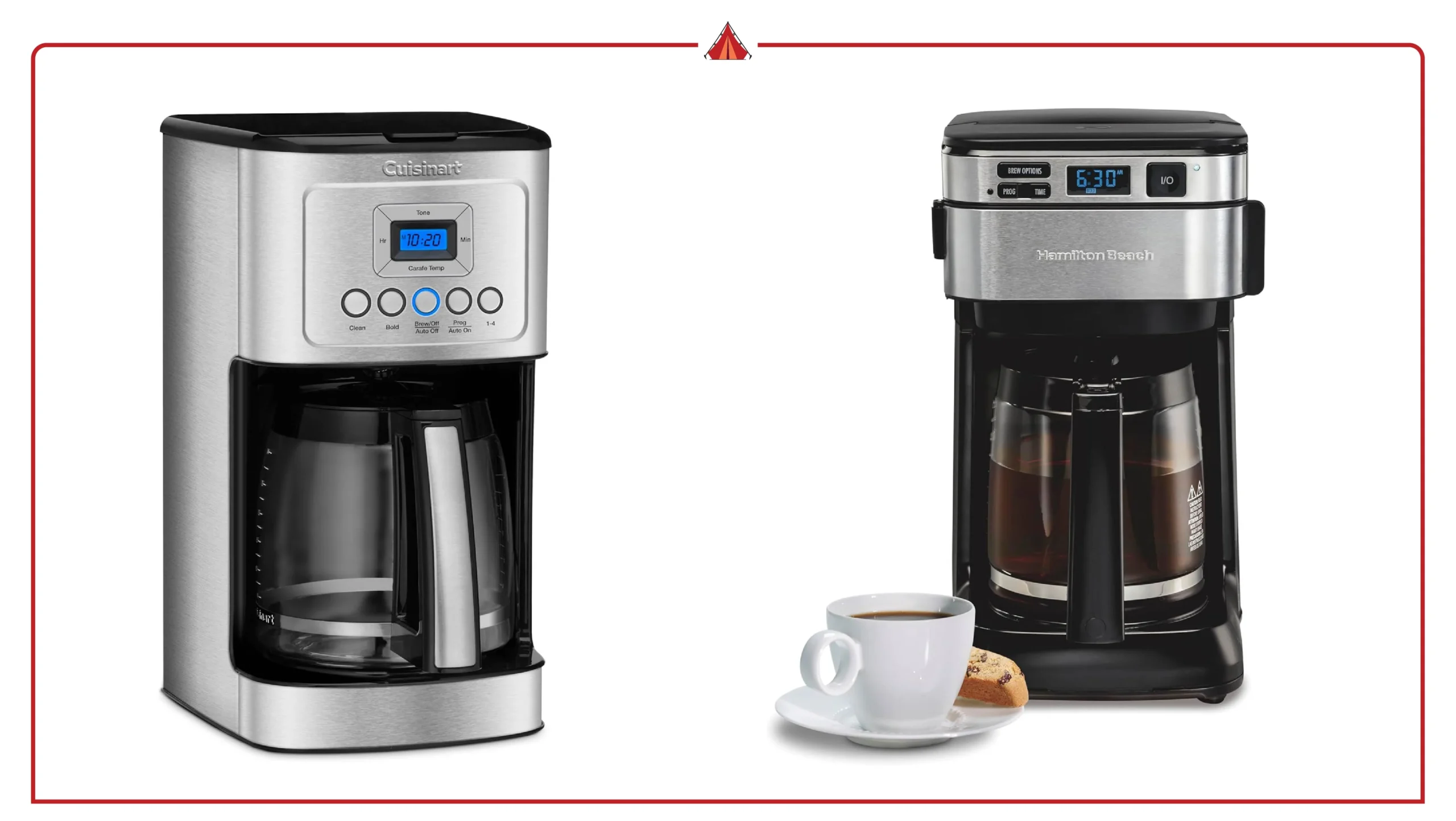
Best Overall Value — Cuisinart DCC-3200P1 PerfecTemp 14-Cup
The DCC-3200P1 is the clearest argument for spending a little more on a Cuisinart. It brews at the right temperature, gives you real control over brew strength, and holds up to daily use without feeling flimsy. If you want a machine that gets out of the way and quietly does its job well for years, this is it.
Check price on Amazon →
Best Budget Pick — Hamilton Beach 49350 12-Cup
If your goal is a reliable daily brewer that doesn’t ask much of you and doesn’t cost much either, the Hamilton Beach 49350 delivers exactly that. Programmable, straightforward to use, and easy to live with — it’s the right machine for buyers who want coffee, not a relationship with their appliance.
Check price on Amazon →
Best for Mixed Households — Hamilton Beach FlexBrew Trio
When one person in the house wants a full pot and another wants a single cup, the FlexBrew Trio solves the problem without forcing anyone to compromise. It’s a practical machine at a practical price, and it handles both brewing styles better than most combo units in its range.
Check price on Amazon →
Cuisinart vs Hamilton Beach: Side-by-Side Comparison
| Product | Brand | Capacity | Best For | Standout Feature |
|---|---|---|---|---|
| DCC-3200NAS PerfecTemp | Cuisinart | 14-Cup | Daily family brewing | PerfecTemp brewing temperature control |
| DCC-T20 Touchscreen | Cuisinart | 14-Cup | Tech-forward buyers | Backlit LCD touchscreen interface |
| SS-15P1 Coffee Center | Cuisinart | 12-Cup + Single-Serve | Mixed households | Dual carafe and K-Cup brewing system |
| DCC-3400P1 Thermal | Cuisinart | 12-Cup | Keeping coffee hot without a warming plate | Double-walled stainless steel thermal carafe |
| 49350 12-Cup | Hamilton Beach | 12-Cup | Budget everyday brewing | Front-fill reservoir with bold brew option |
| 49351 12-Cup | Hamilton Beach | 12-Cup | First-time buyers | Simple two-button interface with auto-shutoff |
| FlexBrew Trio | Hamilton Beach | 12-Cup + Single-Serve | Mixed households on a budget | Three brew modes including pod and ground coffee |
| BrewStation Dispensing | Hamilton Beach | 12-Cup | No-carafe convenience | Internal dispensing tank — no glass carafe to break |
Cuisinart Coffee Makers Reviewed
Cuisinart has been making kitchen appliances long enough to know what daily use actually demands. Their coffee maker lineup reflects that — most models are built around temperature consistency, brew strength control, and programmability that holds up over time rather than features added for the sake of a spec sheet. Here’s how each of their four models in this comparison performs for real buyers.
Cuisinart DCC-3200NAS PerfecTemp 14-Cup — Best Overall Cuisinart
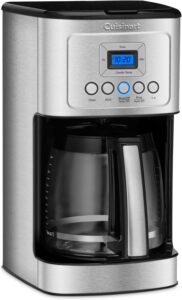
Best for: Families and daily brewers who want consistent, great-tasting coffee from a machine that’s reliable enough to forget about.
The DCC-3200NAS earns its place as the benchmark Cuisinart model because it focuses on the things that actually affect how your coffee tastes. PerfecTemp technology keeps the brewing temperature at the SCAA-recommended range — the detail most budget machines skip entirely, and the reason coffee from this machine tastes noticeably better than coffee from machines that look nearly identical on paper. For anyone who’s ever wondered why their home coffee never quite matches what they get at a good café, water temperature during extraction is usually most of the answer.
Beyond brew quality, the DCC-3200NAS is a genuinely practical machine to live with. The 1–4 cup setting adjusts brewing behavior for smaller batches so you’re not ending up with weak half-pot coffee on slower mornings. The 24-hour programmable clock means coffee is waiting for you rather than the other way around. It’s a 14-cup machine that scales well in both directions — large enough for a full household, smart enough to handle a single person’s morning without wasting effort.
Key Features:
- PerfecTemp heating element maintains optimal brewing temperature throughout the brew cycle
- Bold brew strength setting extracts more flavor for richer, stronger coffee
- 1–4 cup setting adjusts temperature for smaller batch brewing
- Fully programmable 24-hour clock with auto-on and brew-ready alert
- Auto-shutoff with adjustable timer up to 4 hours
Pros:
- Brew temperature consistency produces noticeably better-tasting coffee than most machines in this range
- Flexible batch sizing makes it practical for one person or a full household
- Intuitive controls with no learning curve
Cons:
- Carafe lid can drip slightly when pouring if not seated perfectly before tilting
- Glass carafe means coffee cools faster than a thermal model if left on the warming plate long-term
Cuisinart DCC-T20 Touchscreen 14-Cup — Best for Tech-Forward Brewers
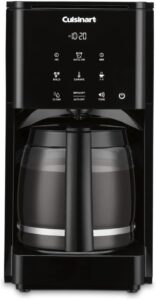
Best for: Buyers who want full programmability and a modern interface and find button-and-dial controls feel outdated.
The DCC-T20 covers essentially the same functional ground as the DCC-3200P1 but wraps it in a touchscreen interface that’s more at home next to a modern kitchen aesthetic. If you find yourself annoyed by physical buttons or want a machine that matches stainless steel appliances without looking like it came from a different decade, the touchscreen experience here is clean and responsive enough to justify the consideration.
Functionally, the DCC-T20 delivers the programmability you’d expect from a flagship Cuisinart — adjustable brew strength, auto-on scheduling, and auto-shutoff up to 4 hours. The included charcoal water filter is a practical bonus that improves taste by removing chlorine and off-flavors from tap water, which makes a meaningful difference if your tap water quality is average or below. Where the DCC-T20 asks for a little patience is the touchscreen sensitivity — it occasionally responds to unintended contact, which is a minor annoyance in a kitchen with wet hands but not a dealbreaker for most buyers.
Key Features:
- Backlit LCD touchscreen with intuitive one-touch brew controls
- Adjustable brew strength with regular and bold settings
- Charcoal water filter included for improved taste
- Auto-shutoff programmable up to 4 hours
- 14-cup capacity with fully programmable 24-hour scheduling
Pros:
- Clean, modern interface that’s easy to navigate at a glance
- Charcoal water filter adds genuine taste improvement out of the box
- Full programmability matches the DCC-3200P1 at a comparable feature level
Cons:
- Touchscreen can activate unintentionally with light or incidental contact
- Premium feel of the interface doesn’t translate to a meaningful brew quality upgrade over the DCC-3200P1
Cuisinart SS-15P1 Coffee Center — Best Cuisinart for Mixed Households
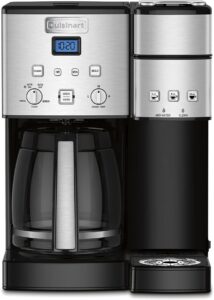
Best for: Households where brewing habits genuinely differ — one person wants a full carafe, another wants a single cup, and neither wants to compromise.
The SS-15P1 is the most versatile machine in the Cuisinart lineup reviewed here, and it earns that distinction by executing both brewing modes competently rather than treating one as an afterthought. The carafe side brews a full 12-cup pot with the same strength control and programmability you’d expect from a standalone Cuisinart drip machine. The single-serve side accepts K-Cup pods and adjusts to three cup sizes — 6, 8, or 10 oz — which covers most single-serve preferences without requiring a separate machine on the counter.
What makes the SS-15P1 a genuine solution rather than a compromise is the independence of both sides. You can run the carafe side on a morning schedule while someone else uses the single-serve side on demand without either function interfering with the other. The tradeoff is footprint — this is a wider machine than either side would be on its own, and it needs a deliberate counter space plan before purchase. But for households that would otherwise own two separate machines, the consolidated footprint is the better outcome.
Key Features:
- Dual brewing system: 12-cup carafe side and independent single-serve side
- Single-serve side compatible with K-Cup pods in 6, 8, and 10 oz sizes
- Brew strength control and programmable auto-on for the carafe side
- Both sides operate independently without interfering with each other
- Auto-shutoff on both brewing systems
Pros:
- Eliminates the need for two separate machines in mixed-preference households
- Both brewing modes perform at a level you’d expect from a dedicated machine
- Flexible single-serve sizing covers most cup preferences
Cons:
- Wider footprint than a standard coffee maker requires deliberate counter space planning
- Single-serve side is pod-dependent — no built-in grinder or ground coffee basket option
Cuisinart DCC-3400P1 Thermal — Best Cuisinart for Keeping Coffee Hot
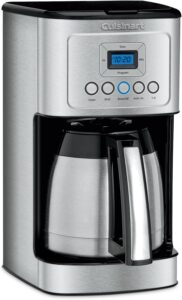
Best for: Buyers who brew a pot in the morning and want it to still taste good two to three hours later — without a warming plate slowly cooking the flavor out.
The core argument for the DCC-3400P1 is simple: warming plates are bad for coffee. They keep liquid hot by applying continuous heat to the bottom of a glass carafe, which degrades flavor compounds over time and produces that stale, bitter taste that makes the second cup of the morning noticeably worse than the first. The DCC-3400P1 sidesteps the problem entirely with a double-walled stainless steel thermal carafe that retains heat through insulation rather than applied heat — and it works. Coffee brewed in the morning holds a genuinely drinkable temperature for up to four hours without any warming element running.
The rest of the machine performs to Cuisinart’s standard — brew strength control, full 24-hour programmability, and a build quality that feels durable rather than disposable. The one friction point is the thermal carafe’s cleaning process. The narrow opening makes a bottle brush necessary rather than optional, and if you’re not thorough about rinsing, coffee oils can accumulate and affect flavor over time. It’s a manageable maintenance habit, but worth knowing before purchase.
Key Features:
- Double-walled stainless steel thermal carafe retains heat for up to 4 hours
- No warming plate — preserves coffee flavor without continued heat application
- Brew strength control with adjustable temperature settings
- Fully programmable 24-hour clock with auto-on
- 12-cup capacity
Pros:
- Thermal carafe produces meaningfully better second and third cups by avoiding warming plate flavor degradation
- Stainless steel build feels premium and holds up to daily handling
- Full programmability matches Cuisinart’s standard drip lineup
Cons:
- Thermal carafe’s narrow opening requires a bottle brush for thorough cleaning
- No glass carafe option — buyers who prefer visual fill-level monitoring will need to adjust
Hamilton Beach Coffee Makers Reviewed
Hamilton Beach has built its reputation on a straightforward premise: reliable appliances at prices that don’t require justification. Their coffee maker lineup doesn’t try to compete with Cuisinart on features or finish — it competes on value, simplicity, and the kind of no-drama daily performance that most coffee drinkers actually need. Here’s how each of their four models in this comparison holds up.
Hamilton Beach 49350 12-Cup — Best Budget Everyday Brewer
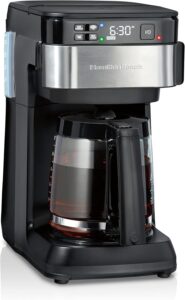
Best for: Budget-conscious buyers who want a dependable daily driver that brews a solid pot, stays out of the way, and doesn’t cost much to replace if something goes wrong.
The 49350 is the model that makes Hamilton Beach’s value case most clearly. It does everything a daily coffee maker needs to do — programmable auto-on, adjustable brew strength, a full 12-cup capacity — without adding complexity or cost that most buyers won’t use. The front-fill water reservoir is a small but genuinely useful design detail that lets you fill the tank without moving the machine or removing the carafe, which matters more than it sounds at 6 a.m.
Brew quality from the 49350 is honest rather than exceptional. It produces a consistent, drinkable pot of coffee that holds its own against machines that cost significantly more for everyday use. Where it shows its budget positioning is on warming plate behavior — left on for more than an hour, the plate runs hot enough to push coffee toward bitter territory. The practical fix is simple: brew, pour, and turn it off. But buyers who leave a pot sitting through the morning should factor that into the decision.
Key Features:
- Programmable clock with auto-on for wake-up brewing
- Adjustable brew strength with bold setting for stronger coffee
- Front-fill water reservoir for easy refilling without moving the machine
- Brew Pause feature lets you pour a cup mid-brew cycle
- Auto-shutoff after 2 hours
Pros:
- Delivers reliable, consistent brew performance at an entry-level price point
- Front-fill reservoir design is more practical than rear-fill alternatives
- Simple controls with no setup friction — functional within minutes out of the box
Cons:
- Warming plate runs hot and can scorch coffee left sitting for extended periods
- Auto-shutoff at 2 hours is shorter than most competing machines in this range
Hamilton Beach 49351 12-Cup — Best for First-Time Buyers
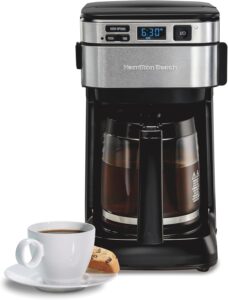
Best for: First-time coffee maker owners, college students, or anyone replacing a broken machine who wants something simple, functional, and easy to operate without a manual.
The 49351 is deliberately uncomplicated, and that’s exactly the point. Where some entry-level machines achieve low prices by cutting features buyers actually use, the 49351 cuts the features buyers don’t — what remains is a clean two-button interface, a programmable clock, and a brew-pause function that lets you steal a cup before the cycle finishes. For a buyer who finds the settings menus on mid-range machines unnecessarily complicated, this is a genuinely more pleasant machine to use every morning.
Brew quality is consistent and appropriate for the price tier. The drip-stop spout on the glass carafe is a small design win that prevents the counter drips that plague cheaper carafes when you pour without perfect technique. The tradeoff for the simplified approach is brew customization — there’s no bold brew setting, so buyers who drink strong coffee and want to dial that in will find the 49351 limiting. For everyone else, it brews a clean, reliable pot without asking anything of the person holding the cup.
Key Features:
- Two-button interface — simple enough for any user to operate immediately
- Programmable clock with auto-on for scheduled morning brewing
- Brew Pause feature allows mid-cycle pouring without mess
- Drip-stop carafe spout prevents counter drips when pouring
- 2-hour auto-shutoff with audible ready alert
Pros:
- Lowest-friction setup and daily operation of any machine in this comparison
- Drip-stop carafe design reduces mess during pouring
- Consistent, reliable brew output for a no-fuss daily routine
Cons:
- No bold brew setting limits customization for strong coffee drinkers
- Basic feature set will feel limiting as brewing preferences develop over time
Hamilton Beach FlexBrew Trio — Best for Mixed Households on a Budget
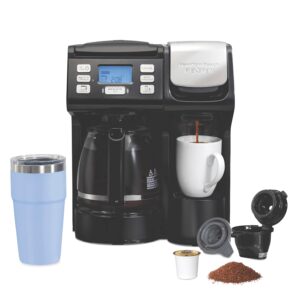
Best for: Households where one person wants a full carafe and another wants a single cup — and the budget doesn’t stretch to a premium dual-system machine like the Cuisinart SS-15P1.
The FlexBrew Trio solves a genuinely common household problem without charging a premium to do it. Three brewing modes — 12-cup carafe, single-serve with ground coffee, and single-serve with pods — cover the full range of morning preferences in most households without requiring anyone to adapt their routine. The single-serve side accommodates travel mugs up to 7 inches tall, which is a practical detail that most single-serve systems overlook and Hamilton Beach gets right here.
Where the FlexBrew Trio distinguishes itself from the Cuisinart SS-15P1 is primarily on price — it delivers comparable household flexibility at a meaningfully lower cost. The honest tradeoff is single-serve speed. The single-serve side brews more slowly than a dedicated pod machine, which matters if the single-cup drinker in the household is usually in a hurry. For households where speed is secondary to flexibility and value, it’s a well-executed machine. For households where the single-serve user needs coffee fast every morning, the slower brew time is worth factoring in before purchase.
Key Features:
- Three brew modes: 12-cup carafe, single-serve with pods, single-serve with ground coffee
- Single-serve side fits travel mugs up to 7 inches tall
- Independent brew strength controls for carafe and single-serve sides
- Programmable auto-on for the carafe side
- Compact dual-system footprint relative to running two separate machines
Pros:
- Three brew modes cover virtually every morning preference in a mixed household
- Travel mug compatibility on the single-serve side adds genuine daily convenience
- Delivers dual-system flexibility at a lower cost than comparable Cuisinart combo units
Cons:
- Single-serve side brews noticeably slower than a dedicated pod machine
- Programmability limited to the carafe side — single-serve side is manual only
Hamilton Beach BrewStation — Best for No-Carafe Convenience
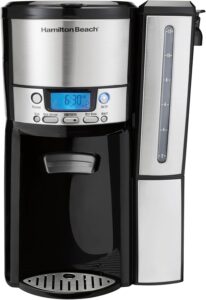
Best for: Buyers who are tired of broken carafes, drips when pouring, or the general inconvenience of handling a glass carafe every morning — and want a machine that dispenses coffee directly.
The BrewStation is the most distinct machine in this comparison because it removes the carafe entirely. Coffee brews directly into an insulated internal tank and dispenses on demand by pressing a cup against a dispensing lever — no lifting, no pouring, no risk of a cracked carafe ending the machine’s life early. For buyers who’ve replaced a glass carafe once already, or who share a machine with people who aren’t careful with glassware, the no-carafe design solves a real problem in a way no other machine here does.
The insulated tank keeps coffee at a drinkable temperature for up to four hours, which puts it in the same practical range as the Cuisinart DCC-3400P1 thermal model — but at a considerably lower price point. The tradeoff is cleaning. The internal tank is harder to access than a removable carafe, requires more deliberate maintenance to prevent coffee oil buildup, and can retain odors if not cleaned regularly with a descaling solution. Buyers who are consistent about machine maintenance will get reliable long-term performance. Buyers who prefer low-maintenance appliances may find the cleaning routine a friction point over time.
Key Features:
- Carafe-free design — coffee brews and dispenses from an insulated internal tank
- Dispenses by pressing a cup against the built-in lever — no pouring required
- Insulated internal reservoir keeps coffee hot for up to 4 hours
- Programmable auto-on with bold brew setting and auto-shutoff
- 12-cup capacity
Pros:
- Eliminates broken carafe risk entirely — a meaningful long-term durability advantage
- Dispensing mechanism reduces mess and effort compared to traditional pouring
- Insulated tank maintains coffee temperature without a warming plate
Cons:
- Internal tank is harder to clean thoroughly than a removable carafe
- Tank can retain odors over time without regular descaling maintenance
Cuisinart vs Hamilton Beach — How They Compare
Individual product reviews tell you what each machine does. This section tells you what actually separates the two brands — and which one is the right fit depending on how you use your coffee maker, how long you expect it to last, and what you’re actually willing to pay for.
Build Quality and Durability
This is where the price gap between the two brands is most visible and most justified. Cuisinart machines generally use heavier plastics, tighter assembly tolerances, and components that feel less prone to wear over a multi-year lifespan. The carafes seal more cleanly, the lids seat more precisely, and the overall handling experience feels more considered. That’s not an accident — it’s where a meaningful portion of the cost difference goes.
Hamilton Beach machines are not poorly built. For the price tier they occupy, they’re well-constructed and hold up to normal daily use without issue. The distinction is longevity under consistent heavy use. A Cuisinart running two full pots a day in a busy household is likely to outlast a Hamilton Beach running the same load — not because Hamilton Beach cuts corners, but because Cuisinart builds with that kind of sustained demand in mind. For light to moderate daily use, both brands will serve most buyers for several years without problems.
The one durability advantage Hamilton Beach holds is the BrewStation’s carafe-free design. Glass carafes — on any brand — are the most common single point of failure in a drip coffee maker’s lifespan. Eliminating that component entirely removes the most likely reason you’d need to replace the machine ahead of schedule.
Read Next: Best Coffee Maker and Espresso Machine Combo: 9 Machines That Do Both Well
Brew Performance and Flavor
Cuisinart’s PerfecTemp technology is the clearest performance differentiator between the two brands. Brewing at the correct water temperature — between 195°F and 205°F — extracts more of the desirable flavor compounds from coffee grounds and fewer of the bitter ones. Most budget machines, including Hamilton Beach’s lineup, don’t hold temperature consistently through the full brew cycle, which is one of the primary reasons coffee from an entry-level machine often tastes flatter or more bitter than the same beans brewed on a higher-end machine.
In practical terms, this means Cuisinart machines — particularly the DCC-3200P1 and DCC-3400P1 — produce a noticeably better-tasting cup from the same bag of coffee. If you’re buying pre-ground grocery store coffee and drinking it with milk and sugar, that difference is marginal. If you’re buying quality whole beans and brewing them black or with minimal additives, the temperature consistency gap between the two brands becomes meaningful.
Hamilton Beach’s brew performance is entirely adequate for everyday drinking. It’s not the machine’s fault if coffee tastes mediocre — that outcome usually comes from stale beans or incorrect grind size, not the brewer. But for buyers who care about extracting the best possible flavor from good coffee, Cuisinart is the more capable tool.
Features and Programmability
Both brands offer programmable auto-on, brew strength adjustment, and auto-shutoff across their respective lineups — these are table-stakes features at this market level and neither brand underdelivers on the basics.
Where Cuisinart pulls ahead is in the depth of that programmability and the reliability of its execution. The 24-hour scheduling on Cuisinart machines is consistent and holds settings through power interruptions better than most Hamilton Beach models. The bold brew setting on Cuisinart machines adjusts the brewing process itself — slowing the flow rate to increase contact time between water and grounds — rather than simply reducing water volume, which is the less effective method some budget machines use.
Hamilton Beach’s FlexBrew Trio offers the most feature breadth of any machine in this comparison for its price tier — three brew modes and travel mug compatibility at a cost that undercuts the Cuisinart SS-15P1 significantly. If feature count relative to price is the metric, Hamilton Beach wins that specific comparison. If feature quality and execution depth is the metric, Cuisinart holds the edge.
Read Next: Best Programmable Coffee Maker for Busy Mornings
Ease of Use and Cleaning
Hamilton Beach has a genuine advantage here, and it’s worth stating plainly. Their machines are simpler to set up, simpler to operate daily, and simpler to clean than most Cuisinart models. The 49351 in particular runs on a two-button interface that requires no adaptation period. For buyers who find modern appliance interfaces unnecessarily complicated, Hamilton Beach’s approach is a real quality-of-life improvement.
Cleaning across both brands follows the same basic routine — regular carafe washing, monthly descaling, and filter replacement where applicable. The friction points are the Cuisinart DCC-3400P1’s thermal carafe narrow opening, which requires a dedicated bottle brush, and the Hamilton Beach BrewStation’s internal tank, which demands more deliberate maintenance than a removable carafe. Both are manageable with consistent habits. Neither should factor heavily into a purchase decision unless low-maintenance operation is a specific priority.
The Cuisinart SS-15P1 and Hamilton Beach FlexBrew Trio — the two dual-system machines — add minor cleaning complexity simply by having more components. Pod trays, single-serve drip trays, and dual water paths all need periodic attention. Neither is burdensome, but buyers upgrading from a single-system machine should expect a modest increase in maintenance time.
Who Should Buy Cuisinart
Cuisinart is the right choice if any of the following apply:
You care about how your coffee actually tastes and want a machine that extracts flavor correctly rather than just heating water and running it through grounds. You brew two or more pots daily and want a machine built to handle sustained heavy use over several years. You want a thermal carafe option that keeps coffee genuinely hot without a warming plate degrading the flavor. You’re willing to spend more upfront in exchange for a machine you won’t need to think about replacing for a long time.
Who Should Buy Hamilton Beach
Hamilton Beach is the right choice if any of the following apply:
Your primary requirement is a reliable daily brewer at the lowest reasonable cost, and incremental brew quality improvement is not worth a price premium to you. You want the simplest possible daily operation and find feature-rich machines unnecessarily complicated. You need a dual-system machine for a mixed household but can’t justify the cost of the Cuisinart SS-15P1. You want a no-carafe dispensing system that eliminates broken glass risk entirely.
Read Next: Ninja vs Breville Coffee Maker: Which One Is Worth Buying?
Frequently Asked Questions
Q: Is Cuisinart better than Hamilton Beach?
A: Cuisinart is the stronger performer on brew quality, build durability, and feature depth — but better depends entirely on what you need from a coffee maker. If consistent brew temperature, long-term durability under heavy use, and programmability depth matter to you, Cuisinart justifies the higher cost. If you want a reliable daily brewer at the lowest reasonable price with minimal setup friction, Hamilton Beach delivers exactly that without meaningful compromise for most buyers.
Q: Which brand lasts longer — Cuisinart or Hamilton Beach?
A: Cuisinart machines generally have a longer service life under sustained heavy use, largely due to heavier component construction and tighter assembly quality. Hamilton Beach machines hold up well for light to moderate daily use and will serve most households for several years without issue. The variable that affects longevity most on either brand is descaling frequency — machines that are descaled regularly outlast neglected machines regardless of brand.
Q: Are Hamilton Beach coffee makers good enough for daily use?
A: Yes, without qualification for most buyers. Hamilton Beach machines brew consistent, drinkable coffee, hold up to daily operation, and include the programmability features most households actually use. The gap between Hamilton Beach and Cuisinart matters most to buyers who drink high-quality beans black and want maximum flavor extraction — for everyone else, Hamilton Beach performs well above what its price suggests it should.
Q: Does Cuisinart make coffee that tastes better than Hamilton Beach?
A: In controlled conditions using the same beans and grind, yes — Cuisinart’s PerfecTemp brewing technology maintains water temperature in the optimal extraction range more consistently than Hamilton Beach machines, which produces a cleaner, fuller-flavored cup. The practical taste difference is most noticeable when brewing quality whole beans without milk or sugar. For buyers using pre-ground grocery store coffee with additives, the flavor gap between the two brands narrows considerably.
Q: Which is easier to clean — Cuisinart or Hamilton Beach?
A: Hamilton Beach machines are generally easier to clean on a daily basis due to simpler component layouts and wider carafe openings that accommodate a standard sponge. The main exception is the BrewStation’s internal dispensing tank, which requires more deliberate maintenance than a removable carafe. On the Cuisinart side, the DCC-3400P1’s thermal carafe narrow opening requires a bottle brush for thorough cleaning. For standard glass carafe models on either brand, cleaning effort is comparable and minimal.
Read Next: Keurig vs Nespresso: Which Coffee Maker Should You Actually Buy?
Final Verdict — Which Brand Offers Better Value in 2026?
Neither brand is the wrong answer. The honest verdict is that Cuisinart and Hamilton Beach serve two genuinely different buyer profiles, and the right choice comes down to which profile matches yours more closely.
Cuisinart is the better long-term investment for buyers who brew daily, care about flavor quality, and want a machine built to handle sustained use without showing its age prematurely. The PerfecTemp temperature consistency, the build quality advantage, and the thermal carafe option on the DCC-3400P1 collectively justify the higher spend for buyers who will actually notice and use those advantages.
Hamilton Beach is the smarter buy for buyers who want reliable, no-drama daily coffee at the lowest reasonable cost — and who have no interest in paying for features that won’t change their morning routine. The 49350 in particular delivers an honest, consistent brew at a price that makes it easy to replace without regret if something goes wrong several years down the line, which is a legitimate value calculation that more expensive machines can’t match.
The FlexBrew Trio sits in its own category as the best-value dual-system machine in this comparison — if your household has mixed brewing preferences and a limited budget, it solves the problem more efficiently than any alternative here.
Best Overall: Cuisinart DCC-3200P1 PerfecTemp 14-Cup
For buyers who want the best daily brew quality and long-term reliability at a mid-range price — this is the machine to buy.
Best Budget Pick: Hamilton Beach 49350 12-Cup
For buyers who want a dependable daily brewer without spending more than necessary — Hamilton Beach makes the value case clearly.
Best Premium Value: Cuisinart DCC-3400P1 Thermal
For buyers who want coffee that stays genuinely hot for hours without flavor degradation — the thermal carafe upgrade is worth every penny.
Best for Mixed Households: Hamilton Beach FlexBrew Trio
For households with different brewing preferences and a budget that doesn’t stretch to the Cuisinart Coffee Center — the FlexBrew Trio solves the problem without the premium price tag.