
Best 12-Cup Coffee Maker for Families and Offices in 2026


This post contains affiliate links. We may earn a commission if you purchase through our links, at no extra cost to you.
A 12-cup coffee maker should be the hardest-working appliance in your kitchen or break room. It needs to brew fast, stay hot, and hold up through dozens of cycles a week without producing a pot that tastes like it came from a gas station. The problem is that most machines at this size sacrifice something — brew temperature, carafe quality, or build durability — in exchange for a lower price tag or a longer feature list.
If you’ve stood in front of a coffee aisle (or an Amazon results page) trying to figure out whether the Breville is actually worth three times the price of the Hamilton Beach, or whether a thermal carafe really makes a difference, you’re in the right place. This guide breaks down the best 12-cup coffee makers available right now — across every budget and use case — so you can stop second-guessing and start brewing a better pot.
Whether you’re outfitting a busy family kitchen, stocking a small office, or replacing a machine that finally gave out, there’s a clear right answer for your situation. Here’s how to find it.
The Best 12-Cup Coffee Makers at a Glance
Not ready to read the full breakdown? Here are the top three picks for most buyers:
- Best Overall: Breville Precision Brewer Thermal — SCAA-certified brew temperature, stainless thermal carafe, and multiple brew modes make this the most complete 12-cup machine available at a non-luxury price.
- Best Budget: Hamilton Beach 46310 — Two-way brew functionality, programmable timer, and a compact footprint at a price that’s hard to argue with.
- Best for Offices: Technivorm Moccamaster KBG 741 — Handmade, dual-certified, and built to last decades. The choice for environments where coffee quality is non-negotiable and the machine runs all day.
Still deciding? The full reviews and buyer’s guide below will tell you exactly which machine fits your situation.
Best 12-Cup Coffee Makers Compared
| Product | Brand | Capacity | Best For | Standout Feature |
|---|---|---|---|---|
| Precision Brewer Thermal | Breville | 12 cups | Coffee enthusiasts | SCAA-certified brew temperature |
| DCC-3200NAS PerfecTemp | Cuisinart | 14 cups | Busy families | Adjustable keep-warm settings |
| OXO Brew 12-Cup | OXO | 12 cups | Consistent extraction | SCA-certified rainmaker shower head |
| 46310 Programmable | Hamilton Beach | 12 cups | Budget buyers | Two-way brew — carafe or travel mug |
| CE251 Programmable | Ninja | 12 cups | Value-seeking households | Freshness indicator + pause-and-pour |
| BVMC-SJX33GT | Mr. Coffee | 12 cups | First-time buyers | Grab-a-Cup auto-pause |
| Moccamaster KBG 741 | Technivorm | 10 cups | Offices and serious brewers | Dual-certified, 5-year warranty |
| CM2046S Thermal | BLACK+DECKER | 12 cups | Thermal on a budget | Vortex water flow technology |
| EC-YSC100 Fresh Brew Plus | Zojirushi | 10 cups | Extended office use | 4-hour vacuum thermal retention |
Breville Precision Brewer Thermal — Best Overall 12-Cup Coffee Maker

Who it’s best for: Coffee drinkers who want café-quality results from a home or office machine and are willing to pay for the engineering behind it.
Most 12-cup coffee makers heat water to somewhere in the 185–192°F range — warm enough to brew, but not warm enough to extract everything worth tasting from a quality ground. The Breville Precision Brewer Thermal closes that gap by hitting the SCAA-certified 197–204°F sweet spot consistently, which means you’re actually tasting what your coffee is supposed to taste like. Pair that with a stainless steel thermal carafe that holds heat for hours without a warming plate slowly scorching your pot, and you have a machine that respects the coffee from start to finish.
What separates the Precision Brewer from other machines at its tier is the range of brew modes. The Fast setting gets a full carafe done quickly without a significant quality drop. Gold Cup follows SCAA guidelines precisely. My Brew lets you dial in your own temperature and bloom time if you want to get granular. For most households, you’ll set it to Gold Cup and never look back — but the flexibility is there if you want it. This is the machine for buyers who have been tolerating mediocre coffee from a $40 drip maker and are ready to understand what they’ve been missing.
Key Features:
- Brews at SCAA-certified 197–204°F for full extraction
- Stainless steel thermal carafe — no warming plate required
- Multiple brew modes: Fast, Gold Cup, My Brew
- Pre-infusion bloom cycle saturates grounds before full brew
- Compatible with flat-bottom and cone filters
Pros:
- Consistently produces one of the best cups available from a drip machine at any price
- Thermal carafe keeps coffee genuinely hot for 2+ hours without flavor degradation
- Brew mode flexibility suits both casual drinkers and enthusiasts
Cons:
- Higher price point than most buyers in this category are expecting to spend
- Thermal carafe opening is narrow, making deep cleaning more effort than a glass carafe
Cuisinart PerfecTemp — Best Programmable 12-Cup Coffee Maker
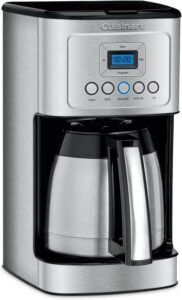
Who it’s best for: Busy households that want a reliable, fully programmable machine with enough flexibility to suit different tastes — without stepping into premium price territory.
The Cuisinart DCC-3200NAS is the machine for families that just want coffee ready when they wake up and don’t want to think about it. The 24-hour programmable timer is straightforward to set, the brew-strength selector handles the gap between light and bold preferences without any fuss, and the adjustable keep-warm temperature means the last person to pour their cup isn’t stuck with bitter, over-heated coffee. It’s a machine designed around the reality of how most households actually use a coffee maker — multiple people, different schedules, different preferences.
Where the Cuisinart earns its place in most kitchens is dependability. It produces a consistent, solid cup at the regular brew setting and a noticeably fuller-bodied result on bold. The 14-cup capacity gives larger households a buffer, and the charcoal water filter helps keep mineral buildup from affecting flavor over time. The trade-off worth knowing about is the glass carafe and warming plate setup — it’s fine if you’re going through a pot within 30–40 minutes, but coffee left sitting for an hour on a warming plate will taste like it. If you drink coffee slowly or brew a pot for later, the BLACK+DECKER or Breville thermal options are the smarter call.
Key Features:
- Fully programmable 24-hour advance brew scheduling
- Brew-strength selector — regular or bold
- Adjustable keep-warm settings: low, medium, high
- Built-in charcoal water filter for cleaner flavor
- 14-cup capacity with ergonomic glass carafe
Pros:
- Reliable daily performance with minimal maintenance required
- Brew-strength and keep-warm customization covers most household preferences
- Strong brand support and widely available replacement parts
Cons:
- Glass carafe on a warming plate degrades coffee flavor if left sitting beyond 45 minutes
- Brew temperature doesn’t reach SCAA-certified range — noticeable to coffee enthusiasts
OXO Brew 12-Cup Coffee Maker — Best for Consistent Extraction
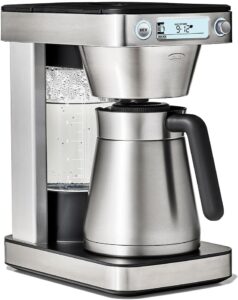
Who it’s best for: Quality-focused buyers who want SCA-certified brewing performance with a simpler, cleaner interface than the Breville — and don’t need multiple brew modes to feel in control.
OXO doesn’t make a lot of coffee makers, but the ones they make are serious. The Brew 12-Cup is SCA-certified, which puts it in a small category of home machines that actually meet the Specialty Coffee Association’s standards for water temperature, brew time, and extraction consistency. What makes it stand out from other certified machines is the rainmaker shower head — a wide, perforated disc that distributes water in a uniform pattern across the entire coffee bed rather than dumping it in the center. The result is even saturation, more complete extraction, and a noticeably cleaner, more balanced cup.
The interface is intentionally minimal — a single dial for brewing, auto-start scheduling, and keep-warm. There’s no brew-strength toggle or temperature customization, which will feel limiting to some buyers and refreshingly straightforward to others. If you want a machine that makes genuinely excellent coffee without requiring you to think about it, the OXO earns that promise. The carafe pours cleanly and the overall build quality feels premium without the premium price of the Breville. For buyers who found the Breville compelling but want something slightly simpler to operate, this is the natural alternative.
Key Features:
- SCA-certified for water temperature and extraction consistency
- Rainmaker shower head for even, full-bed water distribution
- Auto-start scheduling with keep-warm function
- Single-dial interface — low learning curve
- Borosilicate glass carafe with comfortable grip handle
Pros:
- SCA certification means extraction quality is verified, not just claimed
- Even water distribution produces a noticeably more balanced cup than standard machines
- Clean, intuitive design with no unnecessary features to navigate
Cons:
- No brew-strength customization — what you get is what you get
- Glass carafe and warming plate setup is a step down from thermal alternatives at this price
Hamilton Beach 46310 — Best Budget 12-Cup Coffee Maker

Who it’s best for: Budget-conscious buyers who want a dependable everyday machine with practical features — particularly households where someone regularly needs coffee in a travel mug rather than a carafe.
The Hamilton Beach 46310 doesn’t try to compete with the Breville or OXO on brew science, and it doesn’t need to. What it offers is a genuinely useful feature set at a price that removes all friction from the buying decision. The standout is the two-way brew system — you can brew a full 12-cup carafe for the household or swing the brew head over and fill a travel mug directly, bypassing the carafe entirely. For anyone who grabs coffee on the way out the door most mornings, this is a more useful daily feature than any brew-temperature certification.
Programmability is solid for the price — 24-hour delay brew, auto-shutoff, and a compact design that actually fits under standard upper cabinets, which is a detail that matters more than buyers expect until their new machine doesn’t fit. The coffee it produces is honest and consistent: not exceptional, but reliably drinkable and never harsh. The brew strength is fixed, so if bold coffee is a priority this machine will disappoint — but for a household that drinks a moderate amount of regular coffee each morning and values practicality over precision, the Hamilton Beach 46310 is the easiest recommendation in the category.
Key Features:
- Two-way brew — 12-cup carafe or direct-to-travel-mug
- Programmable 24-hour delay brew with auto-shutoff
- Compact, under-cabinet-friendly design
- Pause-and-pour mid-brew capability
- Simple one-touch operation
Pros:
- Two-way brew functionality is genuinely practical for on-the-go households
- Compact footprint works in tight kitchens where space is a real constraint
- Consistent, reliable performance at a price that’s easy to justify
Cons:
- No brew-strength adjustment — produces a standard-intensity cup only
- Warming plate can affect flavor quality if coffee sits for more than 30–40 minutes
Ninja CE251 — Best Value Pick for Everyday Households
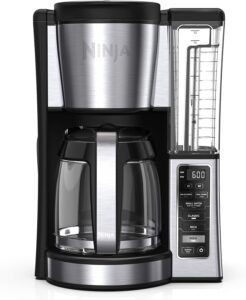
Who it’s best for: Value-seeking households that want programmable convenience and a modern design without paying mid-range prices — particularly buyers who’ve outgrown a basic machine but aren’t ready to spend up.
The Ninja CE251 sits in a useful middle position in this category — more capable than the Mr. Coffee and Hamilton Beach entry-level options, but priced well below the Breville and OXO tier. The 24-hour delay brew and mid-cycle pause-and-pour are expected at this price, but the freshness indicator is a genuinely practical addition that most competitors skip. It tracks how long the coffee has been sitting and alerts you when it’s past its best — a small feature that makes a real difference in households where the pot gets brewed and forgotten for an hour before anyone pours a second cup.
Brew quality is competent and consistent. The Ninja runs slightly cooler than SCAA-certified machines, which coffee enthusiasts will notice but most everyday drinkers won’t. The warming plate keeps coffee at a reasonable temperature for the two-hour auto-shutoff window, and the carafe handles and pours cleanly. Where the CE251 earns its place is in the overall package — it looks better on a counter than most machines at this price, operates simply, and produces a reliable cup morning after morning. For households that want a step up from bare-bones without a significant jump in spend, it delivers exactly what it promises.
Key Features:
- 24-hour programmable delay brew with mid-cycle pause-and-pour
- Freshness indicator tracks how long coffee has been sitting
- Adjustable warming plate with 2-hour auto-shutoff
- Clean, modern design with intuitive controls
- 12-cup glass carafe with ergonomic handle
Pros:
- Freshness indicator is a practical, genuinely useful feature at this price point
- Reliable daily performance with minimal setup or learning curve
- Modern aesthetic works well in updated kitchens
Cons:
- Brew temperature runs below SCAA standards — noticeable to quality-focused drinkers
- Glass carafe and warming plate combination limits how long coffee stays enjoyable
Mr. Coffee BVMC-SJX33GT — Best Entry-Level 12-Cup Coffee Maker
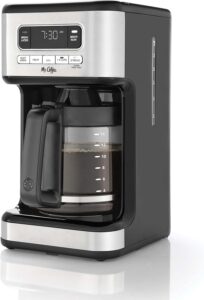
Who it’s best for: First-time buyers, renters, or anyone who needs a functional 12-cup machine at the lowest possible entry point with no learning curve whatsoever.
Mr. Coffee built its reputation on simplicity, and the BVMC-SJX33GT delivers exactly that. Fill the reservoir, add grounds, press brew — the machine handles everything else. The 24-hour programmable timer and Grab-a-Cup auto-pause cover the two features most everyday coffee drinkers actually use, and the adjustable auto-shutoff window between zero and four hours adds a layer of safety and energy-consciousness that buyers at this price don’t always expect. There’s nothing here that will impress a coffee enthusiast, but that’s not who this machine is for.
The honest trade-off is build quality. The plastic-heavy construction feels lightweight in a way that signals lifespan limitations, and the brew temperature doesn’t get close to extraction-optimized ranges. For someone outfitting a first apartment, a guest room, or a secondary kitchen space where the machine won’t run every day, those trade-offs are entirely acceptable. For a primary household machine expected to run twice a day for the next five years, the Hamilton Beach or Ninja options offer meaningfully better durability and features for a modest price increase. The Mr. Coffee earns its place as the entry point — a capable, no-commitment machine for buyers who just need coffee made.
Key Features:
- Simple one-touch programming with 24-hour delay brew
- Grab-a-Cup auto-pause for mid-brew pouring
- Adjustable auto-shutoff: 0–4 hours
- Removable filter basket for easy cleaning
- 12-cup glass carafe with comfort grip handle
Pros:
- Lowest barrier to entry in the category — simple, affordable, functional
- Grab-a-Cup pause works reliably and prevents counter mess
- Widely available replacement carafes and parts
Cons:
- Lightweight plastic construction raises questions about long-term durability
- Brew temperature and extraction quality are noticeably below mid-range competitors
Technivorm Moccamaster KBG 741 — Best Premium 12-Cup Coffee Maker for Offices
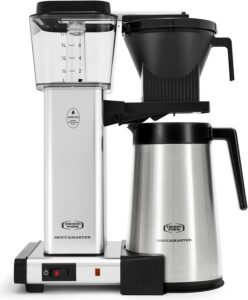
Who it’s best for: Office environments, serious home brewers, and anyone who considers coffee a non-negotiable daily experience and wants a machine built to last decades rather than years.
The Moccamaster is in a different conversation from every other machine in this guide. It’s handmade in the Netherlands, carries both SCAA and ECBC dual certification — a distinction almost no home brewer holds — and comes with a five-year warranty that reflects genuine confidence in its construction. It brews a full 40-ounce pot in under six minutes at a consistently precise 196–205°F, which means you’re getting maximum extraction every single time without babysitting the process. In an office setting where a machine runs five to eight cycles a day, that combination of speed, quality, and durability is worth every dollar of the premium.
What the Moccamaster doesn’t offer is equally important to understand before buying. There’s no programmable timer, no brew-strength selector, no keep-warm plate cycling through temperature settings. You fill it, you brew it, you drink it. The thermal carafe holds heat well enough that the absence of a warming plate is never a problem, but buyers accustomed to waking up to a pre-programmed pot will need to adjust their expectations. This is a machine for people who are present for their coffee — who start the brew intentionally and drink it while it’s fresh. For that buyer, in any setting, the Moccamaster is the clearest long-term investment in the category. [IL: is the Technivorm Moccamaster worth it]
Key Features:
- SCAA and ECBC dual-certified — meets the highest home brewing standards globally
- Brews 40 oz. in under 6 minutes at 196–205°F
- Handmade in the Netherlands with a 5-year manufacturer warranty
- Copper heating element for fast, precise temperature control
- Stainless steel thermal carafe — no warming plate needed
Pros:
- Dual certification and handmade construction represent the top of the drip coffee category
- Five-year warranty and decades-long lifespan make it a genuine long-term investment
- Brew speed and temperature consistency are unmatched at this machine type
Cons:
- No programmability — requires manual brewing every time
- Premium price demands a level of coffee commitment that not every buyer has
BLACK+DECKER CM2046S Thermal — Best Thermal Carafe on a Budget

Who it’s best for: Buyers who want the temperature-retention benefits of a thermal carafe without paying Breville or Zojirushi prices — a practical middle ground for households tired of stale warming-plate coffee.
The core appeal of the BLACK+DECKER CM2046S is straightforward: it gives you a stainless steel thermal carafe at a price point where most competitors are still selling glass carafes on warming plates. If you’ve ever come back to a pot of coffee that’s been sitting for 45 minutes and found it bitter and flat, you understand why that matters. The thermal carafe holds heat passively for two or more hours without the flavor degradation that a warming plate introduces over time — and the CM2046S delivers that benefit without requiring a significant budget commitment. [IL: best coffee maker with thermal carafe]
The Vortex technology water flow system improves ground saturation compared to standard single-point drip designs, and the 24-hour programmable timer with auto-shutoff covers the convenience features most buyers want. Brew quality is solidly mid-range — better than entry-level machines, not in the same tier as SCAA-certified options. The one friction point worth flagging is the carafe’s narrow opening, which makes thorough cleaning more effort than it should be. Running a cleaning cycle monthly and using a bottle brush regularly will keep it performing well. For buyers whose primary complaint about their current machine is that the coffee gets cold and stale too fast, this is the most direct and affordable solution in the category.
Key Features:
- Stainless steel thermal carafe retains heat 2+ hours without a warming plate
- Vortex water flow technology for improved ground saturation
- Programmable 24-hour timer with auto-shutoff
- Easy-fill water reservoir with clear level markings
- 12-cup capacity with durable stainless exterior
Pros:
- Thermal carafe at a budget-friendly price is the standout value proposition in this category
- Vortex water flow produces better extraction than standard single-drip designs
- Programmable convenience without a premium price tag
Cons:
- Narrow carafe opening makes deep cleaning more difficult than it should be
- Brew temperature doesn’t reach certified extraction standards
Zojirushi EC-YSC100 Fresh Brew Plus — Best for Keeping Coffee Hot the Longest

Who it’s best for: Office environments or households that brew a large batch and need it to stay genuinely hot for several hours — particularly settings where people pour at different times throughout the morning.
Zojirushi built its reputation on thermal retention, and the EC-YSC100 brings that expertise directly to the drip coffee category. The double-wall vacuum thermal carafe keeps coffee hot for up to four hours — a meaningful step above the two-hour performance of most thermal carafes in this guide, and a practical difference in office environments where someone is still pouring a cup at 11am from a 7am brew. The stainless steel-lined brew basket contributes to a clean, neutral cup flavor by avoiding the plastic taste that cheaper baskets can introduce over time.
Programmability is solid — the timer, clock display, and keep-warm cycle handle daily scheduling reliably. Where the Zojirushi asks buyers to make a concession is capacity: the carafe runs slightly smaller than competitors at the same price point, which matters in offices where headcount is high or households where multiple people drink multiple cups. For settings where the primary need is a machine that brews well and keeps coffee genuinely hot for an extended window, the EC-YSC100 earns its place clearly. For settings where total volume per brew cycle is the priority, the Cuisinart or Hamilton Beach options offer more capacity for a comparable or lower spend.
Key Features:
- Double-wall vacuum thermal carafe for up to 4-hour heat retention
- Stainless steel-lined brew basket for clean, neutral flavor
- Programmable timer with clock display and keep-warm cycle
- Durable stainless exterior with a compact, office-appropriate footprint
- Easy-clean removable water reservoir lid
Pros:
- Four-hour thermal retention is the strongest heat-keeping performance in this guide
- Stainless steel brew basket produces a noticeably cleaner cup over time
- Reliable programmability suits consistent daily office or household routines
Cons:
- Carafe capacity runs slightly smaller than competitors at the same price point
- Limited availability of replacement parts compared to major brands like Cuisinart or Hamilton Beach
How to Choose the Best 12-Cup Coffee Maker for Your Home or Office
Buying a 12-cup coffee maker looks simple until you’re staring at nine options with overlapping specs and no clear signal about which one actually fits your situation. The decision comes down to five variables — and once you know where you land on each one, the right machine becomes obvious.
Carafe Type: Glass vs. Thermal — Which Is Right for You?
This is the single most consequential decision in the 12-cup coffee maker category, and most buyers don’t think about it until they’ve already made the wrong choice once.
A glass carafe with a warming plate is the standard setup on most machines at the budget and mid-range tier. It keeps coffee visually accessible and is easy to clean. The problem is physics: a warming plate maintains temperature by applying continuous low heat to the bottom of the carafe, which slowly scorches the coffee the longer it sits. A pot that tastes fine at the 20-minute mark will taste noticeably bitter and flat by the hour mark. If your household goes through a full pot within 30 minutes of brewing, a glass carafe is perfectly fine and saves you money.
A thermal carafe uses insulated, double-wall construction to retain heat passively — no ongoing heat source required. Coffee stays genuinely hot for two to four hours depending on the carafe quality, and flavor holds up far better because nothing is cooking it from below. The trade-off is that thermal carafes cost more, are harder to clean, and don’t give you a visual read on how much coffee remains. For offices, slow-morning households, or anyone who brews a pot and comes back to it across an hour or more, the thermal option is worth the premium every time.
Read Next: Best Drip Coffee Maker for Home Use in 2026
Why Brew Temperature Matters More Than Most People Think
Most drip coffee makers heat water to somewhere between 185°F and 192°F. That’s warm enough to dissolve soluble compounds from the grounds — but not warm enough to extract the full range of flavors that a quality coffee is capable of producing. The result is a cup that tastes flat, slightly sour, or just generically “coffee-ish” rather than reflecting the character of the bean.
The Specialty Coffee Association certifies machines that consistently brew between 197°F and 205°F — the range where extraction is complete, balanced, and repeatable. In this guide, the Breville Precision Brewer Thermal, OXO Brew, and Technivorm Moccamaster all hit that certified range. The difference is noticeable if you use quality beans and grind fresh. If you’re buying pre-ground coffee from a standard grocery store brand, the temperature gap will matter less — but it’s still the reason a certified machine produces a cleaner, fuller cup even under those conditions.
If brew quality is a priority, pay attention to whether a machine is SCA or SCAA-certified before you buy. It’s one of the few spec claims in this category that’s independently verified rather than self-reported.
Read Next: Best Coffee Maker for Small Kitchens and Tight Counter Space (2026)
Programmability: What Features Are Actually Worth Having?
Every machine in this guide offers some form of programmability, but not all programmable features deliver equal value. Here’s how to think about what actually matters for your situation.
The 24-hour delay brew timer is the one feature worth having on almost any machine. Being able to set up your coffee the night before and wake up to a freshly brewed pot is a genuine quality-of-life improvement that most buyers use daily once they have it. If a machine doesn’t offer this, it’s a meaningful gap.
Brew-strength selectors — the ability to choose between regular and bold — are useful but not essential. Bold mode typically extends the brew cycle slightly to increase extraction, producing a fuller-bodied cup. It’s a worthwhile feature if people in your household have different strength preferences, but not something worth paying a premium for on its own.
Keep-warm temperature adjustment, as found on the Cuisinart DCC-3200P1, is underrated. The difference between a low and high keep-warm setting significantly affects how long coffee stays enjoyable on a warming plate. If you’re buying a glass carafe machine, look for adjustable keep-warm rather than a fixed-temperature plate.
Freshness indicators, brew-pause functions, and one-touch operation are convenience features that improve the daily experience without changing the fundamental quality of the coffee. Worth having if they come included — not worth choosing a machine specifically for.
Read Next: Best Programmable Coffee Maker for Busy Mornings (2026)
Family vs. Office Use — How Volume Demands Change the Decision
The right machine for a household of two drinks coffee very differently from the right machine for an office of ten, even if both are technically shopping for a 12-cup coffee maker.
For families, the key variables are morning timing, household size, and whether people drink their coffee quickly or slowly. A family of four that brews one pot in the morning and finishes it within 30 minutes can use any machine in this guide without compromise. A household where people pour cups across a two-hour window needs a thermal carafe. A household where different people want different brew strengths benefits from a strength selector.
For offices, volume and durability become the primary concerns. A machine running five to eight cycles a day will exhaust a consumer-grade coffee maker within a year or two. The Technivorm Moccamaster is the only machine in this guide explicitly built for that kind of daily load — its commercial-grade copper heating element and five-year warranty reflect a fundamentally different durability standard than the rest of the field. For light office use of one to two pots a day, the Zojirushi or Breville handle the load well. For anything heavier, the Moccamaster is the responsible choice.
Read Next: Keurig vs Nespresso: Which Coffee Maker Should You Actually Buy in 2026?
Build Quality and Longevity — What to Look for Before You Buy
A $40 coffee maker that lasts two years costs more over a decade than a $200 machine that lasts fifteen. That math matters when you’re deciding how much to spend upfront.
The most reliable indicators of build quality in this category are heating element material, carafe construction, and country of manufacture. Copper heating elements, as found in the Technivorm, heat faster, hold temperature more precisely, and outlast the standard aluminum elements found in budget machines. Stainless steel carafes outlast glass carafes in almost every real-world setting. Machines manufactured in Europe or Japan — the Technivorm and Zojirushi, respectively — tend to reflect higher component standards than budget-tier machines assembled for maximum cost efficiency.
Warranty length is a useful proxy for manufacturer confidence. The Technivorm’s five-year warranty and the Breville’s two-year warranty both signal machines their makers expect to keep running. A 90-day or one-year warranty on a machine you plan to use twice daily is worth factoring into your true cost of ownership before you check out.
Read Next: Best Coffee Maker Under $100 That Actually Makes Great Coffee (2026)
FAQ
Q: What is the best 12-cup coffee maker overall?
A: The Breville Precision Brewer Thermal is the best 12-cup coffee maker for most buyers. It’s SCAA-certified, brews at the optimal temperature range, and pairs that brew quality with a stainless steel thermal carafe that keeps coffee hot without a warming plate. It hits the sweet spot between genuine performance and a price that’s premium but not unreachable. Buyers who want the absolute best without any compromise on quality or durability should look at the Technivorm Moccamaster instead.
Q: Is a thermal carafe better than a glass carafe with a warming plate?
A: For most buyers, yes — particularly anyone who doesn’t finish a full pot within 30 minutes of brewing. A warming plate applies continuous heat to the bottom of the carafe, which gradually scorches the coffee and produces a bitter, flat taste over time. A thermal carafe retains heat passively through insulation, which means the coffee at the two-hour mark tastes close to what it tasted like fresh. The trade-off is that thermal carafes are harder to clean and cost more. If your household goes through coffee quickly, a glass carafe is a reasonable and more affordable choice.
Q: Do 12-cup coffee makers actually brew 12 full cups?
A: Not quite — at least not 12 standard 8-ounce cups. Most manufacturers measure a “cup” at 5 to 6 ounces, which means a 12-cup machine typically produces 60 to 72 ounces of brewed coffee. That’s roughly 7 to 9 standard mugs depending on how generously you pour. It’s worth knowing before you buy, especially for offices or larger households where headcount is close to the machine’s stated capacity.
Q: What brew temperature should a good 12-cup coffee maker reach?
A: The Specialty Coffee Association recommends a brew temperature between 197°F and 205°F for optimal extraction. Most budget and mid-range machines brew between 185°F and 192°F, which is warm enough to produce drinkable coffee but not warm enough to extract the full flavor range from quality grounds. If brew temperature matters to you, look for machines that are SCA or SCAA-certified — that certification is independently verified, not self-reported.
Q: Are programmable coffee makers worth it for home use?
A: The 24-hour delay brew timer alone makes programmability worth having for most households. Being able to set up your machine the night before and wake up to fresh coffee is a daily convenience that adds up quickly. Beyond that, features like brew-strength selectors and adjustable keep-warm are genuinely useful but not essential. The machines in this guide that skip programmability entirely — like the Technivorm Moccamaster — compensate with exceptional brew quality and durability, which is a reasonable trade-off for buyers who prioritize the cup over the convenience.
Q: How long do 12-cup coffee makers typically last?
A: Budget machines used daily typically last two to four years before heating element or pump failures become common. Mid-range machines from brands like Cuisinart, OXO, and Ninja generally run four to seven years with basic maintenance. Premium machines like the Breville Precision Brewer are built to last a decade or more, and the Technivorm Moccamaster is explicitly designed for 10 to 20 years of use — its five-year warranty and copper heating element reflect that standard. Descaling every one to three months, depending on your water hardness, is the single most effective way to extend the lifespan of any machine in this category.
Read Next: Best Coffee Maker with Built-In Grinder in 2026: Fresh Ground, Zero Hassle
Final Verdict
The best 12-cup coffee maker isn’t the same machine for every buyer — but the decision is simpler than the number of options makes it look.
Best Overall: Breville Precision Brewer Thermal. If you drink coffee daily, care about what’s in your cup, and want a machine that will hold up for years, this is the one to buy. SCAA-certified brew temperature, a stainless thermal carafe, and genuine brew mode flexibility make it the most complete machine in this guide at a non-luxury price point. Most buyers who land here won’t need to look further.
Best Budget: Hamilton Beach 46310. If your priority is reliability and practicality at the lowest reasonable spend, the Hamilton Beach delivers without meaningful compromise for its tier. The two-way brew functionality — carafe or travel mug — is a feature that earns its keep every single morning for on-the-go households.
Best Premium and Best for Offices: Technivorm Moccamaster KBG 741. If you’re outfitting an office that runs coffee all day, or you’re a home brewer who considers this a long-term investment rather than an appliance purchase, the Moccamaster is in its own category. Dual-certified, handmade, warrantied for five years, and built to last two decades — it earns its price over time in a way that most machines in this category simply cannot.
Best Thermal Carafe on a Budget: BLACK+DECKER CM2046S. If your main frustration is stale warming-plate coffee but you’re not ready to spend up for the Breville, this is the most direct solution. Thermal retention at a budget price, with solid programmability included.
Best for Extended Office Use: Zojirushi EC-YSC100. If coffee needs to stay genuinely hot across a long morning window — not just warm, but hot — the Zojirushi’s four-hour vacuum retention is the strongest performance in this guide for that specific need.
The through-line across every pick in this guide is the same: match the machine to how your household or office actually uses coffee, not to a spec sheet. Buy for your real morning, and the right machine will pay for itself in better coffee and fewer replacements.