
Best Coffee Maker and Espresso Machine Combo in 2026: 9 Machines That Do Both Well

This post contains affiliate links. We may earn a commission if you purchase through our links, at no extra cost to you.
Most kitchens have a problem that nobody talks about enough: two machines taking up counter space where one should be enough. The drip coffee maker for weekday mornings. The espresso machine for weekend lattes. Two power cords, two footprints, two things to clean.
Combo machines promise to solve that — but the category has a reputation for compromise. Buy one machine that does both, the thinking goes, and you end up with mediocre espresso and forgettable drip coffee. That reputation isn’t entirely wrong. Plenty of combo machines on the market deliver exactly that kind of disappointment.
This list isn’t those machines.
Every pick below was selected because it performs both functions at a level worth recommending — not just one. Whether you’re after a true 15-bar espresso pull alongside a full 12-cup carafe, a pod-based setup that handles lattes and drip without the learning curve, or the most capable machine your budget allows, there’s a genuine option here for your kitchen and your morning routine.
Quick Answer: Best Coffee Maker Espresso Combos at a Glance
Not ready to read the full breakdown? Here are the top three picks for most buyers:
Best Overall: De’Longhi All-in-One COM532M — a dual heating system that runs real espresso and full-carafe drip coffee simultaneously, without flavor crossover. The most balanced performer on this list for households that use both functions daily.
Best for Pod Users: Keurig K-Café Special Edition — if your household runs on K-Cups and you want lattes and cappuccinos without learning manual espresso technique, this is the most convenient path to both.
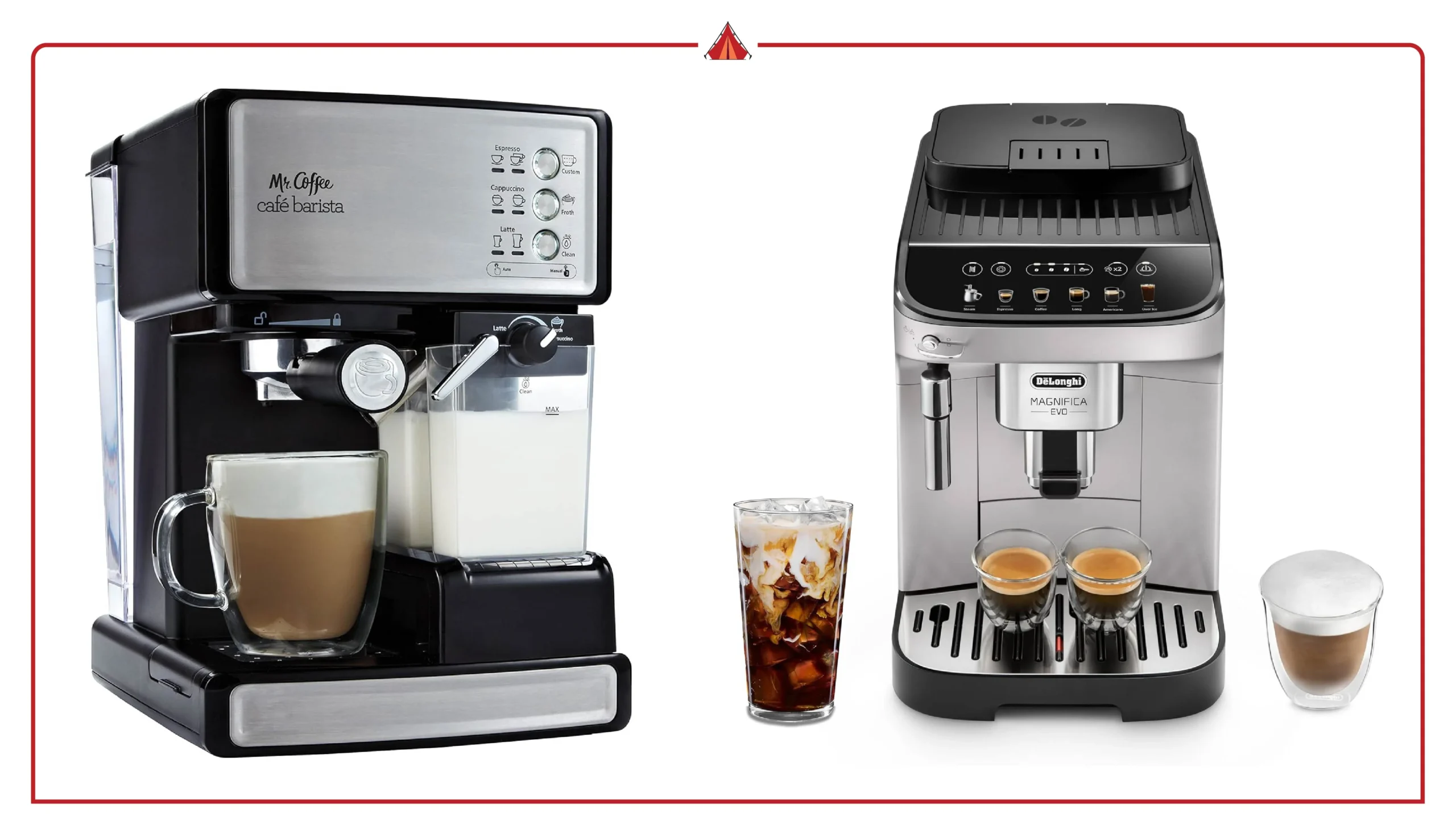
Best Budget Pick: Mr. Coffee BVMC-ECMP1000 — a 15-bar espresso machine with a built-in one-touch cappuccino maker at an entry-level price. The most accessible way to get genuine espresso pressure and drip coffee from one machine.
Combo Machine Comparison: 2026 Top Picks
| Product | Brand | Carafe Size | Best For | Standout Feature |
|---|---|---|---|---|
| All-in-One COM532M | De’Longhi | 10-cup | Best overall combo | Dual heating system — simultaneous brew |
| Dual Boiler BES920XL | Breville | N/A (standalone pairing) | Serious home baristas | Independent PID temperature control |
| Specialty Coffee Maker CF091 | Ninja | Full carafe | Versatile all-in-one | Six brew sizes + fold-away frother |
| Magnifica Evo ECAM29043SB | De’Longhi | N/A (espresso-focused) | Bean-to-cup automation | Built-in burr grinder + auto frothing |
| 2-Way Brewer 49350 | Hamilton Beach | 12-cup | Budget dual-brew households | Independent carafe + pod sides |
| K-Café Special Edition | Keurig | Single-serve | Pod-first households | Hot and cold milk frother built in |
| 20-Bar Combo GECME418E-U | Gevi | 10-cup | Mid-range true espresso + drip | 20-bar pump with steam wand |
| Coffee Center SS-16 | Cuisinart | 12-cup | Flexible pod + carafe households | Single-touch unified control panel |
| Espresso & Coffee Maker BVMC-ECMP1000 | Mr. Coffee | 10-cup | Entry-level espresso + drip | One-touch automated cappuccino |
1. De’Longhi All-in-One Combination Coffee Maker & Espresso Machine (COM532M)
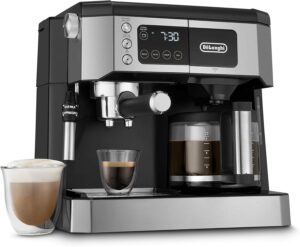
Who it’s best for: Home brewers who want genuine espresso and full-pot drip coffee from a single machine without sacrificing quality on either side.
Most combo machines run a single heating element across both functions, which means the machine is always making a trade-off somewhere — water temperature, pressure, or brew time. The De’Longhi COM532M sidesteps that problem entirely with a dual heating system that runs the espresso side and the drip side independently. That means you can pull a shot while a full carafe is brewing, and neither function interferes with the other. For households where one person wants a latte and another wants a pot of coffee ready at the same time, that’s a genuinely useful capability rather than a marketing claim.
The 15-bar pump delivers the extraction pressure that real espresso requires, and the adjustable milk frother gives you enough control to produce lattes and cappuccinos that don’t taste like a compromise. The drip side produces a clean, properly extracted 10-cup carafe with consistent results across brew cycles. It’s a larger machine — the footprint reflects the dual-system engineering inside — but for buyers who use both functions regularly, the counter space is earning its keep.
Key Features:
- Dual heating system for simultaneous espresso and drip brewing
- 15-bar pump pressure for full espresso extraction
- Adjustable milk frother for lattes and cappuccinos
- 10-cup drip carafe with programmable brew settings
- Compact unified design relative to owning two separate machines
Pros:
- Genuinely performs both functions without meaningful compromise
- Simultaneous brewing is a practical daily-use advantage
- Milk frother produces quality foam without an external tool
Cons:
- Larger countertop footprint than most standalone machines
- Learning curve for buyers new to manual espresso technique
2. Breville Dual Boiler (BES920XL)
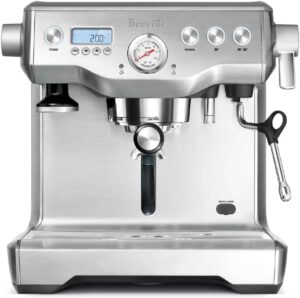
Who it’s best for: Serious home baristas who want best-in-class espresso performance and are willing to invest in the equipment — and the learning — that genuine craft brewing requires.
There is a ceiling on what a true all-in-one combo machine can deliver for espresso quality, and the Breville BES920XL exists above that ceiling. It is not a combo machine in the traditional sense — it pairs with the Breville Precision Brewer on the drip side — but for buyers whose primary concern is espresso quality and who want drip coffee that matches that standard, this pairing represents the most capable setup on this list. The dual boiler architecture means each function has its own dedicated heating element running at the precise temperature its job requires. Espresso extraction and steam pressure operate simultaneously and independently, which eliminates the wait time and temperature compromise that single-boiler machines build into every workflow.
The PID temperature control on both boilers gives you shot-to-shot consistency that most home machines can’t touch, and the integrated shot clock and pressure gauge give you the feedback loop you need to actually improve your technique over time. This is a setup for buyers who treat coffee as a craft. If you want a machine that rewards attention and skill, the Breville dual-boiler pairing delivers returns that no single-unit combo machine currently matches.
Key Features:
- Independent dual boiler system with PID temperature control on each
- Simultaneous espresso extraction and steam pressure — no wait time between functions
- Integrated shot clock and pressure gauge for precision feedback
- SCAA-certified drip performance when paired with Breville Precision Brewer
- Full manual espresso control for experienced home baristas
Pros:
- Best espresso quality of any setup on this list
- PID control delivers shot-to-shot consistency
- Rewards skill development over time — grows with the user
Cons:
- Steeper learning curve than any plug-and-play combo unit
- Premium price point requires genuine commitment to the craft
3. Ninja Specialty Coffee Maker (CF091)
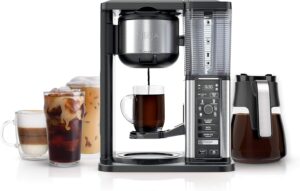
Who it’s best for: Buyers who want a versatile all-in-one machine that handles drip coffee, specialty drinks, and espresso-style concentrate — without the complexity of manual espresso technique.
The Ninja CF091 is the right machine for a specific kind of buyer: someone who wants lattes and cappuccinos as part of their routine but has no interest in learning grind size, tamping pressure, or extraction time. It does not produce true espresso — the CF091 uses a specialty brew mode that concentrates coffee through increased brew strength rather than pump pressure. For drinks like iced lattes, café-style cappuccinos, and flavored coffee drinks, that distinction matters less than you might expect. The concentrate it produces is rich, bold, and works well as an espresso stand-in in milk-based drinks.
Where the CF091 earns its place on this list is versatility. Six brew sizes — from a single cup to a full travel mug to a complete carafe — cover nearly every household scenario, and the fold-away frother is genuinely compact and easy to use. The drip coffee function is consistent and well-regarded. If your household’s definition of espresso drinks means lattes and flavored cappuccinos rather than straight shots pulled for quality, the Ninja CF091 handles that use case well without asking you to develop a new skill set.
Key Features:
- Specialty brew mode produces rich espresso-style concentrate
- Six brew sizes from single cup to full carafe
- Built-in fold-away frother for hot foam drinks
- Classic, rich, over-ice, and specialty brew modes
- Thermal and glass carafe options available
Pros:
- Highly versatile brew size and style options for mixed households
- Fold-away frother keeps the machine compact when not in use
- Low learning curve — accessible for all experience levels
Cons:
- Produces espresso-style concentrate, not true pump-pressure espresso
- Not suitable for buyers who need genuine 9-bar extraction for straight shots
4. De’Longhi Magnifica Evo (ECAM29043SB)
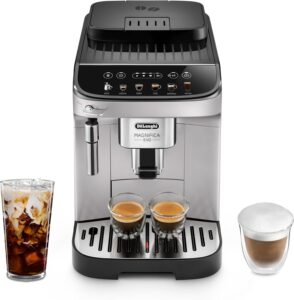
Who it’s best for: Buyers who want a fully automatic bean-to-cup machine that handles espresso, americanos, and milk drinks at the touch of a button — and don’t need a traditional drip carafe.
The Magnifica Evo operates on a different philosophy than the other machines on this list. Where most combo units try to deliver a drip carafe and an espresso function side by side, the Magnifica Evo commits fully to the espresso side and handles volume through automation rather than carafe capacity. The built-in conical burr grinder means you’re going from whole bean to finished drink in one machine, with adjustable grind settings that give you meaningful control over extraction flavor without requiring barista-level knowledge. The LatteCrema system automates milk frothing completely — you select your drink, and the machine handles the rest.
For households where the coffee routine centers on espresso, americanos, cappuccinos, and lattes — and where a pot of drip coffee isn’t part of the daily picture — the Magnifica Evo is the most seamless experience on this list. It is worth being clear, though: if you regularly need a full carafe of brewed coffee for multiple people in the morning, this machine does not cover that use case. It belongs on this list because it genuinely combines grinding, espresso extraction, and milk frothing into one automated unit — but buyers who need both espresso and a drip pot should look at the De’Longhi COM532M instead.
Key Features:
- Built-in conical burr grinder with adjustable grind and dose settings
- LatteCrema automatic milk frothing system
- One-touch brewing for espresso, americano, and cappuccino
- Bean-to-cup automation eliminates manual prep steps
- Compact super-automatic design relative to its capability
Pros:
- Full bean-to-cup automation with no manual steps required
- Built-in grinder eliminates the need for a separate grinder purchase
- Consistent results across every drink type with minimal user input
Cons:
- No traditional drip carafe — not suited for households that brew by the pot
- Higher upfront investment than most drip-focused combo machines
5. Hamilton Beach 2-Way Brewer (49980RG)
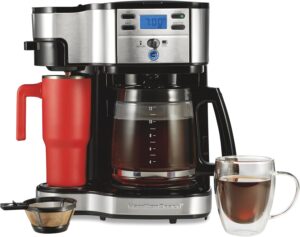
Who it’s best for: Budget-conscious households that want the flexibility of a full 12-cup carafe and single-serve pod brewing from one machine — without paying a premium price for the convenience.
The Hamilton Beach 49980RG doesn’t pretend to be something it isn’t, and that honesty is part of what makes it worth recommending in its category. This is not an espresso machine. It is a dual-function drip brewer that handles a full 12-cup carafe on one side and K-Cup pod brewing on the other — two completely independent systems sharing one countertop footprint. For households where different people want different things from their morning coffee routine, that independence is genuinely useful. One person brews a full pot while another pops in a pod, and neither has to wait for the other.
Where the 49980RG earns its spot on this list is in the gap it fills for buyers who’ve been searching “coffee maker espresso combo” but whose real need is flexible household brewing rather than true espresso extraction. If your household’s definition of variety means drip coffee for the early riser and a quick single-serve cup for the late starter — rather than pulled espresso shots and steamed milk — the Hamilton Beach handles that use case cleanly at a price point that leaves most of the competition behind. Go in with accurate expectations and it will not disappoint.
Key Features:
- Independent 12-cup drip carafe and single-serve pod sides
- Compatible with K-Cup pods for single-serve brewing
- Programmable drip side with auto-brew scheduling
- Compact unified design for a dual-function machine
- Removable water reservoir on single-serve side for easy filling
Pros:
- Two fully independent brew systems in one footprint
- Accessible price point for households that want dual-function convenience
- Programmable carafe side handles early-morning scheduling
Cons:
- Does not produce true espresso — single-serve side brews standard pod coffee only
- Build quality reflects the budget price tier over long-term use
6. Keurig K-Café Special Edition
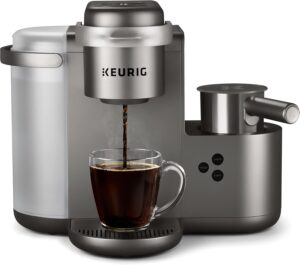
Who it’s best for: Pod-first households that want lattes and cappuccinos as part of their daily routine without learning manual espresso technique or committing to a steep learning curve.
Keurig built its entire business on removing friction from the morning coffee routine, and the K-Café Special Edition extends that philosophy into espresso-style drinks without asking anything more of the user. The shot brew mode produces a strong, concentrated cup from a standard K-Cup pod — it is not true espresso in the pump-pressure sense, but in a latte or cappuccino built with properly frothed milk, the difference is difficult to detect for most drinkers. The built-in milk frother handles both hot and cold foam, which means iced lattes are as accessible as hot cappuccinos, and the whole workflow from pod to finished drink takes under two minutes.
What the K-Café does better than any other machine on this list is eliminate the decision tax that comes with learning a new piece of equipment. There are no grind settings to dial in, no tamping technique to develop, no temperature variables to manage. You choose your pod, select your brew size, froth your milk, and drink your latte. For households that are already running on K-Cups and want to expand their drink menu without expanding their skill set, that simplicity is a genuine advantage. The ongoing pod cost is a real consideration over time, and buyers who want the ability to use fresh ground coffee will find the K-Café’s pod dependency limiting — but for its target buyer, it delivers exactly what it promises.
Key Features:
- Shot brew mode for strong espresso-style concentrate from K-Cup pods
- Built-in milk frother with hot and cold settings
- Brews standard K-Cup sizes plus travel mug capacity
- Descaling reminder and strong brew setting for customization
- Matte finish and premium design relative to standard Keurig models
Pros:
- Lowest learning curve of any espresso-style machine on this list
- Hot and cold frother expands drink menu to iced lattes and cold cappuccinos
- Seamless integration for households already using K-Cup pods
Cons:
- Relies exclusively on K-Cup pods — no option for fresh ground coffee
- Produces espresso-style concentrate rather than true pump-pressure espresso
7. Gevi 20-Bar Espresso and Coffee Maker Combo (GECME418E-U)
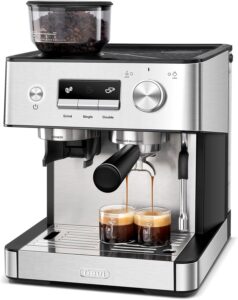
Who it’s best for: Mid-range buyers who want genuine espresso pump pressure alongside a full drip carafe in a single unit — without paying De’Longhi or Breville prices to get there.
The Gevi combo occupies a specific and useful position in this category: it is one of the few machines at a mid-range price point that delivers true 20-bar pump pressure on the espresso side alongside an independent 10-cup drip carafe. That combination is harder to find than it should be. Most machines in this price tier either compromise on espresso pressure — producing concentrate rather than extraction — or deliver a drip carafe so underwhelming it defeats the purpose of a combo purchase. The Gevi manages both functions at a level that justifies its place on this list for buyers whose budget sits below the De’Longhi COM532M but who aren’t willing to give up real espresso pressure.
The steam wand gives you manual control over milk frothing, which rewards a small amount of technique and produces better results than automated frothers once you’ve spent a few sessions learning the angle and temperature. Build quality is the honest limitation here — the Gevi doesn’t feel or last like a De’Longhi or Breville, and buyers who treat their kitchen equipment hard or expect a decade of daily use should factor that into their decision. For buyers who want the full combo feature set at a price that doesn’t require justification, it’s a capable and underrated option.
Key Features:
- 20-bar pump pressure for genuine espresso extraction
- Independent 10-cup drip carafe with separate heating plate
- Steam wand for manual milk frothing and latte art
- Removable drip tray and accessible water reservoir for easy cleaning
- Compact unified footprint for a true dual-function machine
Pros:
- True pump-pressure espresso at a mid-range price point
- Independent drip and espresso systems minimize flavor crossover
- Steam wand gives experienced users meaningful control over milk texture
Cons:
- Build quality and long-term durability fall short of premium brands
- Manual steam wand requires more technique than automated frothers
8. Cuisinart Coffee Center 2-in-1 (SS-16)
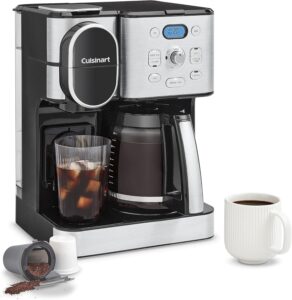
Who it’s best for: Households that want the flexibility of pod-based single-serve and a full 12-cup drip carafe in one machine — with a reliable brand name behind it at a mid-range price.
The Cuisinart SS-16 sits in the same dual-brew category as the Hamilton Beach 49350 but steps up in build quality, control panel refinement, and brand reliability. The drip side delivers a programmable 12-cup carafe with the consistency Cuisinart has built its reputation on — adjustable brew strength, auto-shutoff, and a clean extraction that produces reliably good coffee across a range of ground beans. The single-serve side handles K-Cup pods and Cuisinart’s own cup format, with brew size options that cover everything from a small concentrated cup to a full travel mug.
Like the Hamilton Beach, it’s important to be direct with buyers who land on the SS-16 through an espresso combo search: this machine does not produce espresso. The single-serve side brews pod coffee at standard strength — not espresso-pressure extraction. What it does offer is a well-built, dependable dual-function brewer that handles a wide range of household coffee needs under one footprint with a single-touch control panel that takes almost no learning. For buyers whose household coffee routine involves a morning pot and quick mid-day single cups rather than espresso shots and steamed milk, the Cuisinart SS-16 is one of the cleanest executions of that use case available.
Key Features:
- 12-cup programmable drip carafe with adjustable brew strength
- Single-serve side compatible with K-Cup pods and Cuisinart cups
- Multiple single-serve brew sizes from small cup to travel mug
- Unified single-touch control panel across both functions
- Auto-shutoff and 24-hour programmability on drip side
Pros:
- Reliable Cuisinart build quality at a mid-range price point
- Programmable drip side handles early-morning scheduling with ease
- Clean unified design keeps the countertop organized
Cons:
- Single-serve side does not produce espresso — standard pod brewing only
- Less suitable for buyers whose primary goal is espresso-quality extraction
9. Mr. Coffee Espresso and Coffee Maker (BVMC-ECMP1000)
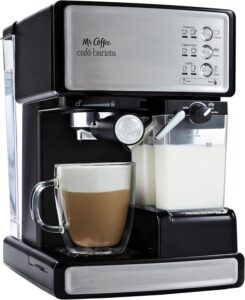
Who it’s best for: Entry-level buyers who want a genuine introduction to espresso and cappuccino making alongside basic drip brewing — at a price point that removes the financial barrier to getting started.
The Mr. Coffee BVMC-ECMP1000 exists for the buyer who has been curious about espresso at home but hasn’t been able to justify the price of a mid-range or premium machine. It brings a 15-bar pump — the same pressure specification as machines costing significantly more — into a package that keeps the entry cost low and the operation simple. The one-touch cappuccino maker automates the milk frothing process, which means buyers who’ve never made an espresso drink at home can produce a recognizable cappuccino on their first attempt without watching a tutorial first.
The drip side covers a 10-cup carafe with basic brew functionality — no programmable scheduling, no brew strength adjustment, but clean and consistent output for a machine in this tier. The honest conversation about the Mr. Coffee combo is durability: this is not a machine built to last ten years of daily use, and buyers who go in expecting premium longevity will eventually be disappointed. What it is built to do is give a first-time espresso buyer a capable, low-risk entry point that covers both brewing functions without requiring a significant investment to find out whether home espresso fits into their routine. For that purpose, it delivers more than its price suggests.
Key Features:
- 15-bar pump pressure for genuine espresso extraction
- One-touch automated cappuccino maker with built-in milk frothing
- 10-cup drip carafe for standard brewed coffee
- Single-touch brew controls for straightforward daily operation
- Compact design suitable for smaller countertop footprints
Pros:
- Genuine 15-bar espresso pressure at the lowest price point on this list
- One-touch cappuccino automation makes espresso drinks accessible to beginners
- Low financial barrier to entry for first-time home espresso buyers
Cons:
- Drip carafe limited to 10 cups with no programmable brew scheduling
- Long-term durability does not match mid-range or premium alternatives
Buyer’s Guide: How to Choose the Right Coffee Maker and Espresso Machine Combo
Buying a combo machine is a different decision than buying a standalone espresso machine or a drip coffee maker. You’re not just evaluating one function — you’re evaluating how well a single unit handles two jobs that have genuinely different engineering requirements. These are the factors that actually matter when you’re narrowing your options.
Read Next: Best Drip Coffee Maker for Home Use
True Espresso vs. Espresso-Style Concentrate — Know the Difference Before You Buy
This is the most important distinction in the entire combo machine category, and most product listings don’t make it clearly enough. True espresso is produced by forcing hot water through finely ground coffee at 9 bars of pressure or more. That pressure is what creates the concentrated shot, the crema on top, and the flavor profile that makes espresso taste like espresso. Machines that deliver this — including the De’Longhi COM532M, the Gevi 20-bar combo, and the Mr. Coffee BVMC-ECMP1000 — use an actual pump to generate that pressure.
Espresso-style concentrate is something different. Machines like the Ninja CF091 and the Keurig K-Café produce a strong, concentrated coffee brew by using more grounds or a slower brew cycle — but without pump pressure. The result tastes bold and works well as a base for milk drinks, but it is not espresso in the technical sense, and in a straight shot it will not produce the same flavor or crema. Neither approach is wrong — but knowing which one you’re buying matters, especially if espresso quality is the reason you’re looking at combo machines in the first place.
Read Next: Best 12-Cup Coffee Maker for Families and Offices
Dual Boiler vs. Single Boiler — What It Actually Means for Daily Use
A single boiler machine heats one reservoir of water and routes it to whichever function you’re using. That means if you want to brew espresso and steam milk in the same session, the machine has to reheat between tasks — which adds time and can introduce temperature inconsistency. Most combo machines in the mid-range use a single boiler or a thermoblock system.
A dual boiler machine, like the Breville BES920XL, runs two independent heating elements — one calibrated for espresso extraction temperature, one for steam pressure. The practical benefit is simultaneous operation with no reheating wait and no temperature compromise between functions. For daily use in a household where multiple drinks are being made back to back, that’s a meaningful workflow advantage. For occasional weekend use, the single boiler wait time is unlikely to bother most buyers.
Carafe Size and Household Fit
If you’re regularly brewing coffee for two or more people in the morning, carafe capacity should be a primary filter before anything else. The Hamilton Beach 49350 and Cuisinart SS-20 both offer 12-cup carafe sides, making them better suited to larger households. The De’Longhi COM532M and Gevi combo top out at 10 cups. The De’Longhi Magnifica Evo and Breville BES920XL don’t offer a traditional drip carafe at all — they’re better suited to households where espresso-based drinks cover the full coffee routine.
If you’re a one or two-person household whose mornings involve a couple of cups each, a 10-cup carafe covers you comfortably. If you’re brewing for four or more, the 12-cup options on this list are worth prioritizing.
Read Next: Best Single Serve Coffee Maker for One Person
Built-In Grinder vs. Pre-Ground — Which Setup Suits You
A built-in grinder, like the one in the De’Longhi Magnifica Evo, means one less appliance on your counter and a fresher cup in your mug — ground coffee begins losing volatile compounds within minutes of grinding, and freshly ground beans produce noticeably better espresso. The trade-off is complexity: grinder maintenance, grind setting adjustments, and occasional clogs become part of your machine ownership experience.
Pre-ground machines are simpler to operate and easier to maintain, and for buyers who buy quality pre-ground espresso or use pods, the difference in cup quality is smaller than the marketing around fresh grinding suggests. If convenience and low maintenance are priorities, pre-ground is the right call. If you’re already buying whole beans and want to maximize what you get from them, a machine with a built-in grinder earns its premium.
Countertop Space and Footprint Planning
Combo machines are sold partly on the promise of saving counter space, but the reality is more nuanced. A true dual-function machine with separate boilers, a full carafe, and a steam wand is often larger than a standalone drip coffee maker — because it’s doing more. The De’Longhi COM532M, for example, is a substantial footprint by any measure. Before purchasing, check the product dimensions against your available counter space and factor in clearance for opening lids, filling reservoirs, and accessing the steam wand.
If counter space is genuinely tight, the Ninja CF091 and Mr. Coffee BVMC-ECMP1000 are among the more compact options on this list. The Keurig K-Café is also relatively slim for a machine with a built-in frother.
Read Next: Best Coffee Maker for Small Kitchens and Tight Counter Space
FAQ
Q: Can a combo machine really make good espresso?
A: Yes — but only if the machine uses a real pump to generate extraction pressure. Machines with a 15-bar or higher pump, like the De’Longhi COM532M, the Gevi 20-bar combo, and the Mr. Coffee BVMC-ECMP1000, produce genuine espresso with proper crema and flavor concentration. Machines that use brew concentration instead of pump pressure — like the Ninja CF091 or Keurig K-Café — produce a bold coffee that works well in milk drinks but is not technically espresso. Know which type you’re buying before you commit.
Q: What is the difference between espresso concentrate and real espresso?
A: Real espresso is made by forcing hot water through finely ground coffee at 9 bars of pressure or more — that pressure extracts flavor compounds and produces the crema layer on a properly pulled shot. Espresso concentrate is brewed coffee made extra strong through a slower, more saturated brew cycle without pump pressure. In a latte or cappuccino with steamed milk, the difference is subtle for most drinkers. In a straight shot, the difference in flavor, texture, and crema is significant.
Q: Are combo coffee and espresso machines worth it?
A: For the right buyer, yes. If your household uses both functions regularly — a morning pot of drip coffee and espresso-based drinks throughout the day — a quality combo machine eliminates a second appliance, a second power cord, and a second cleaning routine without meaningful sacrifice on either side. The De’Longhi COM532M is the clearest example of a combo that earns that trade-off. Where combo machines disappoint is when buyers expect performance that matches dedicated single-function machines at every price point — a $150 combo will not out-pull a $500 standalone espresso machine.
Q: How much counter space does a combo machine typically need?
A: Most combo machines run between 12 and 16 inches wide and 12 to 14 inches deep — larger than a standard drip coffee maker because of the additional components. Always check the specific dimensions of the machine you’re considering before purchasing, and account for lid clearance and steam wand access in your measurement. If counter space is a hard constraint, the Ninja CF091 and Keurig K-Café are among the more compact options on this list.
Final Verdict
The best coffee maker and espresso machine combo for most households is the De’Longhi All-in-One COM532M. Its dual heating system is the engineering detail that separates it from the rest of the mid-range field — it runs both functions simultaneously without compromise, delivers genuine 15-bar espresso pressure, and produces a full 10-cup drip carafe that holds up to daily use. For a household that genuinely uses both sides of a combo machine, it is the most balanced performer on this list.
For buyers who want serious espresso quality above all else, the Breville Dual Boiler BES920XL paired with the Precision Brewer sets the performance ceiling in this category. It asks more in price and learning curve, but it delivers returns that no single-unit combo currently matches.
If budget is the primary filter, the Mr. Coffee BVMC-ECMP1000 brings genuine 15-bar espresso pressure to the lowest price point on this list. Approach it as a capable entry-level machine rather than a long-term investment, and it will exceed expectations.
Pod-first households that want lattes without the learning curve will find the Keurig K-Café Special Edition the most friction-free path to espresso-style drinks and frothed milk — within the limitations of its pod dependency.
And for buyers whose coffee routine is entirely espresso-based, the De’Longhi Magnifica Evo is the most seamless bean-to-cup experience on the list — as long as a drip carafe isn’t part of the picture.
| Pick | Best For |
|---|---|
| De’Longhi COM532M | Best Overall |
| Breville BES920XL | Best for Serious Espresso + Drip |
| Mr. Coffee BVMC-ECMP1000 | Best Budget |
| Keurig K-Café Special Edition | Best for Pod Households |
| De’Longhi Magnifica Evo | Best Fully Automatic |