
Best Drip Coffee Maker for Home Use in 2026


This post contains affiliate links. We may earn a commission if you purchase through our links, at no extra cost to you.
Most drip coffee makers sitting on kitchen counters right now are quietly underperforming. Not broken — just never quite delivering the coffee they’re capable of making. The water doesn’t get hot enough. The grounds don’t saturate evenly. The carafe sits on a warming plate until the coffee tastes like burnt regret.
The good news: the gap between a mediocre drip machine and a genuinely great one is smaller than you think — and it doesn’t always cost more to close it. It just requires knowing what actually matters inside the machine, and which products deliver on it.
This guide covers nine of the best drip coffee makers for home use in 2026, selected across every budget from entry-level to premium. Whether you’re replacing a machine that’s finally given out, upgrading because your morning coffee deserves better, or buying your first standalone brewer, you’ll leave here knowing exactly which one to buy — and why.
Quick Answer: Best Drip Coffee Makers for Home in 2026
Not ready to read the full breakdown? Here are the top three picks for most buyers:
- Best Overall: Breville Precision Brewer Thermal — SCA-certified brewing, pre-infusion bloom, and a thermal carafe that keeps coffee tasting fresh for hours. The closest a drip machine gets to pour-over quality without any extra effort.
- Best Budget Pick: Ninja CE251 Programmable Coffee Maker — Reliable, programmable, and packed with features that most entry-level machines charge extra for. A strong performer at a price that leaves no room for complaints.
- Best for Coffee Purists: Technivorm Moccamaster KBT — Hand-assembled, SCA-certified, and built to last decades. If you care deeply about extraction quality and want a machine that never compromises, this is it.
If one of these fits your needs, jump straight to its review below. If you want to compare all nine options — including large-capacity, two-in-one, and thermal budget picks — the full breakdown and buyer’s guide follow below.
Drip Coffee Maker Comparison Table
| Product | Brand | Capacity | Best For | Standout Feature |
|---|---|---|---|---|
| Precision Brewer Thermal | Breville | 8-Cup | Best Overall | SCA-certified with pre-infusion bloom |
| OXO Brew 9-Cup | OXO | 9-Cup | Best Mid-Range | Rainmaker showerhead for even saturation |
| Moccamaster KBT | Technivorm | 10-Cup | Coffee Purists | Copper boiling element, 5-year warranty |
| DCC-3200NAS PerfecTemp | Cuisinart | 14-Cup | Large Households | Adjustable keep-warm + bold brew setting |
| 8-Cup One-Touch | Bonavita | 8-Cup | Simple Brewing | One-touch operation, thermal carafe |
| CE251 Programmable | Ninja | 12-Cup | Best Budget | Full programmability at entry-level price |
| 2-Way Brewer (49350) | Hamilton Beach | 12-Cup + Single | Two-in-One Use | Brews full carafe or single travel mug |
| CM2046S Thermal | Black+Decker | 12-Cup | Budget Thermal | Thermal carafe without the premium price |
| BVMC-SCX23 | Mr. Coffee | 12-Cup | Entry-Level Basics | Simple one-button operation |
Breville Precision Brewer Thermal — Best Overall

Who it’s best for: Home brewers who want café-quality coffee from a drip machine and aren’t willing to compromise on extraction — without crossing into manual pour-over territory.
Most drip coffee makers approximate good brewing conditions. The Breville Precision Brewer Thermal engineers them deliberately. Water reaches the SCA-recommended 200°F before it ever touches the grounds, and the bloom pre-infusion cycle — borrowed directly from manual pour-over technique — saturates the coffee bed evenly before the full brew begins. The result is a noticeably fuller, more balanced cup than what most drip machines produce, and it happens automatically every single time.
The stainless steel thermal carafe is the other half of what makes this machine worth its price. There’s no warming plate cooking your coffee into bitterness over the next hour — the carafe holds temperature for hours without sacrificing flavor. For anyone who brews a pot and doesn’t drink it immediately, that distinction matters more than almost any other feature on the spec sheet.
Key Features:
- SCA-certified brewing at optimal 200°F water temperature
- Bloom and pulse pre-infusion cycle for even extraction
- Stainless steel thermal carafe — no warming plate
- Multiple brew modes including Gold Cup, Fast Brew, and Iced Coffee
- Compatible with both flat-bottom and cone filters
Pros:
- Consistently produces café-quality coffee with zero manual effort
- Thermal carafe preserves flavor without a hot plate
- Versatile brew modes suit different preferences and occasions
Cons:
- Premium price is a significant jump from mid-range competitors
- 8-cup capacity may not be enough for larger households
OXO Brew 9-Cup Coffee Maker — Best Mid-Range

Who it’s best for: Buyers who want SCA-certified brewing quality and a thermal carafe without paying the premium that Breville or Technivorm commands.
The OXO Brew sits in a genuinely useful middle ground — it’s not a budget machine asking you to accept trade-offs, and it’s not a premium machine asking you to stretch your budget. What it is, is a well-engineered, SCA-certified drip brewer that takes the guesswork out of a good cup. The rainmaker showerhead distributes water across the entire coffee bed in a pattern designed for even saturation, addressing one of the most common failure points in cheaper drip machines where water channels through the center of the grounds and leaves the edges under-extracted.
Operation is kept deliberately simple. A single button starts the brew, and an auto-start scheduling feature lets you wake up to fresh coffee without navigating a complicated interface. The stainless thermal carafe means your coffee stays hot and flavor-intact for hours — and like the Breville, there’s no warming plate involved. At this price point, the combination of SCA certification and a thermal carafe in one machine is genuinely hard to beat.
Key Features:
- SCA-certified with rainmaker showerhead for even saturation
- Stainless steel thermal carafe — no warming plate
- Single-button operation with auto-start scheduling
- Optimal brew temperature maintained throughout the cycle
- 9-cup capacity suits small to medium households
Pros:
- SCA-certified extraction quality at a mid-range price
- Intuitive operation — minimal learning curve
- Thermal carafe protects flavor long after brewing
Cons:
- 9-cup capacity is a limitation for larger households or frequent entertaining
- No brew-strength adjustment or multiple brew mode options
Technivorm Moccamaster KBT — Best for Coffee Purists

Who it’s best for: Serious home brewers who treat coffee as a craft, want a machine built to last decades, and are prepared to pay for the best extraction a drip machine can produce.
The Technivorm Moccamaster is the answer to a very specific question: what happens when a company builds a drip coffee maker with absolutely no corners cut? The result is a hand-assembled Dutch machine with a copper boiling element that hits brewing temperature in under six minutes, SCA certification, and a build quality that owners routinely describe as lasting fifteen to twenty years with basic maintenance. It is not a machine you buy because it’s the most affordable path to a good cup. It’s a machine you buy because you’ve decided that extraction quality and longevity matter more than anything else on the spec sheet.
The KBT variant pairs that brewing engine with a stainless steel thermal carafe, eliminating the warming plate entirely and preserving coffee flavor for hours after brewing. The manual open/close brew basket lid gives experienced brewers a degree of control over extraction that fully automated machines don’t offer. There are no programmable features, no app connectivity, no brew modes — and for the buyer this machine is designed for, that’s the point. It does one thing, and it does it better than almost anything else in its category.
Key Features:
- SCA-certified with copper boiling element reaching optimal temperature in under six minutes
- Hand-assembled in the Netherlands with a five-year warranty
- Stainless steel thermal carafe — no warming plate
- Manual open/close brew basket for extraction control
- Simple, durable design with minimal electronics to fail over time
Pros:
- Exceptional extraction quality that rivals manual pour-over brewing
- Built to last decades — one of the most durable drip machines available
- Five-year warranty backs up the premium price with genuine confidence
Cons:
- Very high price point requires genuine commitment to coffee quality to justify
- No programmability or auto-start — purely manual operation
Cuisinart DCC-3200NAS PerfecTemp — Best Large-Capacity

Who it’s best for: Families, households with multiple coffee drinkers, or anyone who regularly brews full pots and wants programmable convenience built into a reliable, no-fuss machine.
When a household runs through coffee quickly, capacity stops being a nice-to-have and starts being a practical requirement. The Cuisinart DCC-3200NAS addresses that directly with a 14-cup glass carafe — the largest in this roundup — paired with a fully programmable 24-hour auto brew that means a full pot is ready the moment the first person reaches the kitchen. For households where mornings run on volume rather than single-origin precision, that combination of capacity and automation covers the brief better than any other machine here.
The brew-strength selector adds genuine flexibility that most large-capacity machines skip — regular mode suits lighter drinkers, while bold mode extends the brew cycle for a fuller, more concentrated cup. The adjustable keep-warm temperature settings (low, medium, high) give you some control over how the coffee holds over time, which partially addresses the glass carafe’s natural tendency to scorch coffee on a standard hot plate. It won’t preserve flavor as well as a thermal carafe, but it gives you better control than a fixed-temperature plate. For households that empty the pot within an hour, it’s rarely an issue.
Key Features:
- 14-cup capacity — largest in this roundup
- Fully programmable 24-hour auto brew with auto shut-off
- Brew-strength selector for regular or bold coffee
- Adjustable keep-warm temperature (low, medium, high)
- Ergonomic handle and drip-free pour spout on carafe
Pros:
- 14-cup capacity suits large households and frequent entertaining
- Brew-strength control adds flexibility most large-capacity machines lack
- Programmable auto brew makes high-volume morning routines effortless
Cons:
- Glass carafe and warming plate can affect flavor if coffee sits too long
- No thermal carafe option at this capacity level
Bonavita 8-Cup One-Touch Coffee Maker — Best Simple Brewer

Who it’s best for: Buyers who want high-quality extraction and a thermal carafe with the absolute minimum of buttons, settings, and decisions involved in getting a great cup.
There’s a buyer who doesn’t want to program anything, doesn’t want brew modes, and doesn’t want to consult a manual. They want to add water, add grounds, press one button, and drink excellent coffee. The Bonavita 8-Cup One-Touch was built specifically for that person. The interface is a single switch. The brewing is SCA-certified. The thermal carafe holds temperature without a hot plate. Everything about the machine is oriented around removing friction between the user and a well-extracted cup.
What makes the simplicity credible rather than just minimal is what’s happening inside. The flat-bottom showerhead distributes water across the full surface of the coffee bed — a design choice that directly improves extraction consistency compared to machines that pour from a single point. The pre-infusion mode saturates the grounds before the full brew begins, coaxing more even flavor development out of the coffee without requiring any input from the user. For a machine with one button, it produces a cup that outperforms its straightforward appearance by a meaningful margin.
Key Features:
- SCA-certified with flat-bottom showerhead for full saturation
- Pre-infusion mode for even extraction — fully automatic
- Stainless steel thermal carafe — no warming plate
- Single-switch operation — no programming required
- 8-cup capacity suits one to three regular coffee drinkers
Pros:
- Genuinely excellent extraction from a machine with near-zero complexity
- Thermal carafe keeps coffee fresh without a hot plate
- Ideal for buyers who want quality without any learning curve
Cons:
- No programmability or auto-start — you need to be present to brew
- 8-cup capacity limits usefulness for larger households
Ninja CE251 Programmable Coffee Maker — Best Budget Pick

Who it’s best for: Budget-conscious buyers who don’t want to sacrifice programmability or convenience features and are happy with a glass carafe machine that reliably delivers a solid everyday cup.
Most coffee makers at the entry-level price point ask you to accept significant trade-offs — usually in the form of stripped-back features, unreliable temperature control, or build quality that starts showing wear within a year. The Ninja CE251 is the exception that makes the budget category worth shopping. For a price that undercuts most mid-range machines substantially, it delivers a 12-cup programmable brewer with a 24-hour auto brew, mid-cycle brew pause, and a delay brew function that together cover everything most everyday home brewers actually need from a drip machine.
It won’t produce the extraction precision of an SCA-certified brewer. The glass carafe and keep-warm plate mean coffee held for more than thirty to forty minutes will begin to lose its edge. But for a buyer who brews and drinks promptly, refills throughout the morning, or simply wants a dependable machine that starts fresh coffee before they’re out of bed — without spending mid-range money to do it — the CE251 makes a strong, honest case for itself. The mid-cycle pause feature is a particular practical standout: pull the carafe mid-brew for a cup without making a mess, which sounds minor until the morning you actually need it.
Key Features:
- 12-cup capacity with 24-hour programmable auto brew
- Mid-cycle brew pause for pouring before the pot finishes
- Delay brew and keep-warm plate included at entry-level price
- Simple interface with easy-to-read water reservoir markings
- Compact footprint for a 12-cup machine
Pros:
- Full programmability at a price that undercuts most competitors
- Mid-cycle brew pause adds genuine everyday convenience
- Reliable, consistent performance for a no-fuss daily driver
Cons:
- Glass carafe and hot plate affect flavor quality over time
- No thermal carafe option and no brew-strength control
Hamilton Beach 2-Way Brewer — Best Two-in-One

Who it’s best for: Households where one person wants a full pot in the morning and another wants a single cup into a travel mug — without buying two separate machines to solve the problem.
The two-in-one coffee maker category is full of compromises, and it’s worth being direct about that upfront. Machines that try to do two things rarely do either as well as a dedicated single-purpose brewer. The Hamilton Beach 2-Way Brewer is the best version of that trade-off currently available — and for the right household, the trade-off is genuinely worth making. The carafe side brews a full 12-cup pot with programmable auto brew and keep-warm. The single-serve side brews directly into a travel mug using ground coffee, with no pod requirement and no proprietary system to buy into.
What separates the 2-Way Brewer from cheaper two-in-one alternatives is that both sides function independently and consistently. You’re not toggling a shared heating element between modes or working around a system clearly designed with one use case as the afterthought. The single-serve side handles most standard travel mug sizes, and the carafe side covers the programmable morning routine that multi-person households depend on. Neither side will outperform a dedicated machine at the same price — but if counter space is limited and two coffee drinkers have genuinely different needs, this is the most practical single solution available.
Key Features:
- Brews a full 12-cup carafe or a single serving into a travel mug
- Compatible with ground coffee on both sides — no pods required
- Programmable auto brew and keep-warm on the carafe side
- Single-serve side fits most standard travel mug sizes
- Independent operation — both sides function separately
Pros:
- Solves the two-drinker, two-preference problem in one machine
- No pod system required — works with any ground coffee
- Programmable carafe side handles the full morning routine
Cons:
- Neither brew mode matches the performance of a dedicated single-purpose machine
- Single-serve side lacks brew-strength control or temperature adjustment
Black+Decker CM2046S Thermal Coffee Maker — Best Budget Thermal
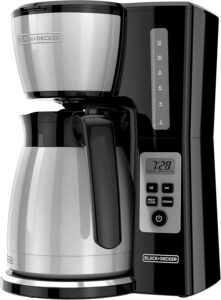
Who it’s best for: Budget buyers who specifically want a thermal carafe machine — and don’t want to pay mid-range prices to get one — and are willing to accept a modest step down in build quality to close that gap.
The thermal carafe is one of the most meaningful upgrades available in a drip coffee maker. It eliminates the warming plate entirely, preserving coffee flavor for hours after brewing without the slow scorching effect that glass carafe machines are prone to. The problem is that thermal carafe machines typically start at mid-range prices, which puts them out of reach for buyers working with tighter budgets. The Black+Decker CM2046S exists to close that gap — and for the most part, it does.
Brew quality is solid for its price tier. The Vortex Technology water flow system improves saturation compared to the basic single-point pour found on many entry-level machines, and the result is a more evenly extracted cup than the price alone would suggest. The programmable auto brew and Sneak-a-Cup pause feature cover the practical bases. Where the CM2046S shows its price point most clearly is in build quality — the plastics feel less substantial than rivals, and long-term durability is a more realistic concern here than with machines at higher price points. For buyers who plan to upgrade in a few years and want thermal carafe performance in the meantime, that’s an acceptable trade. For buyers looking for a machine to last a decade, it’s worth stretching the budget further.
Key Features:
- Stainless steel thermal carafe — no warming plate
- Vortex Technology water flow for improved ground saturation
- Programmable auto brew with 24-hour scheduling
- Sneak-a-Cup pause feature for mid-brew pouring
- 12-cup capacity suits most household sizes
Pros:
- Thermal carafe performance at a budget-friendly price point
- Programmable auto brew covers the morning routine basics
- Improved saturation over standard entry-level machines
Cons:
- Build quality feels noticeably less premium than competitors at similar or slightly higher prices
- Thermal carafe retention not as strong as higher-end models over extended periods
Mr. Coffee BVMC-SCX23 — Best Entry-Level
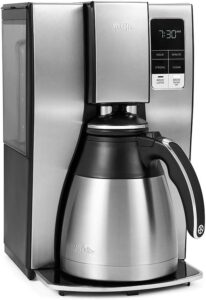
Who it’s best for: First-time buyers, renters, or anyone who needs a dependable, no-fuss 12-cup drip machine at the lowest possible price and has no interest in features beyond the basics.
There is a version of the coffee maker buying decision that looks like this: you need something that brews coffee, holds twelve cups, doesn’t take up too much counter space, and costs as little as possible. No programmability required. No thermal carafe needed. No brew modes, no pre-infusion, no certifications. Just coffee, reliably, every morning. The Mr. Coffee BVMC-SCX23 is the right answer to that question — and it’s worth being clear that it isn’t trying to be the right answer to any other question.
What it does, it does without complaint. The 12-cup glass carafe fills quickly, the keep-warm plate holds temperature adequately for an hour or so, and the Grab-a-Cup auto pause means you can pull the carafe mid-brew without cleaning up a mess. Replacement carafes and filters are widely available and inexpensive, which matters more than it sounds for a machine at this price point — when something breaks or wears out, you’re not hunting for proprietary parts. It won’t produce a cup that rivals SCA-certified machines, and the warming plate will affect flavor if coffee sits too long. But for a buyer whose priority is functional simplicity at the lowest entry cost, the Mr. Coffee delivers exactly what it promises and nothing it doesn’t.
Key Features:
- 12-cup glass carafe with keep-warm plate
- Grab-a-Cup auto pause for mid-brew pouring
- Simple one-button operation — no programming required
- Widely available replacement carafes and paper filters
- Compact design for standard counter space
Pros:
- Lowest price point in the roundup with reliable everyday performance
- Simple operation with zero learning curve
- Widely available replacement parts and accessories
Cons:
- No programmability, brew-strength control, or thermal carafe option
- Keep-warm plate affects flavor quality over time — best consumed promptly
How to Choose the Best Drip Coffee Maker for Your Home
Buying a drip coffee maker gets complicated fast — not because the machines are hard to understand, but because the marketing around them makes it difficult to separate the features that genuinely affect your cup from the ones that exist to justify a higher price tag. This guide cuts through that. Here’s what actually matters, what’s worth paying for, and how to match a machine to the way you actually drink coffee.
What Makes a Good Drip Coffee Maker?
Two variables determine the quality of a drip coffee maker more than anything else on the spec sheet: water temperature and saturation coverage.
Water temperature is the most important and the most commonly compromised. The Specialty Coffee Association recommends brewing between 197°F and 205°F, with 200°F considered optimal. Most budget machines never reach that range consistently — they brew cooler, which means the water doesn’t extract the full range of soluble compounds from the grounds. The result is a flat, underdeveloped cup that tastes thin regardless of how good your coffee beans are. Machines that are SCA-certified have been independently tested and confirmed to hit that temperature window reliably. That certification is one of the clearest buying signals available in this category.
Saturation coverage is the second factor. Water needs to contact the entire coffee bed evenly — not pour through a single point in the center and leave the edges of the grounds under-extracted. Better machines use showerhead systems, rainmaker heads, or pulse-brew cycles to distribute water across the full surface. Cheaper machines skip this, and the result shows up in the cup as inconsistency — some brews taste fine, others taste weak, and you can never quite identify why.
Everything else — programmability, carafe type, capacity, brew modes — matters, but it matters second. A machine that nails temperature and saturation will produce better coffee than a feature-rich machine that doesn’t.
Thermal Carafe vs Glass Carafe: Which Is Better?
This is one of the most practical decisions in the drip coffee maker category, and the answer depends almost entirely on your drinking habits.
A thermal carafe keeps coffee hot through insulation — no external heat source required. Coffee held in a thermal carafe for two to three hours tastes substantially closer to freshly brewed than coffee held on a warming plate for the same period. If you brew a pot and drink it gradually over the course of a morning, a thermal carafe is a meaningful upgrade that directly affects the quality of every cup after the first.
A glass carafe relies on a warming plate to maintain temperature. The plate keeps coffee hot, but it also continues to cook it — and coffee that sits on a warming plate for more than thirty to forty minutes begins to taste noticeably bitter and flat. If you brew a pot and drink it within that window, the difference between a glass and thermal carafe is minimal in practice. If you regularly let coffee sit longer, the warming plate is actively working against you.
The trade-off: thermal carafe machines typically cost more, and the carafes themselves are harder to clean thoroughly. Glass carafes are easier to inspect for cleanliness and less expensive to replace. For most buyers who prioritize flavor over convenience, thermal wins. For buyers who brew and consume quickly and want to keep costs down, glass is a perfectly reasonable choice.
How Many Cups Do You Actually Need?
Capacity matching is straightforward in principle and regularly overthought in practice. A few honest guidelines:
A single coffee drinker or a couple where only one person drinks coffee rarely needs more than an 8-cup machine. The OXO Brew and Bonavita both top out at 8 to 9 cups and are better machines for their price than most of the 12-cup options at the same level.
A household of two to three regular coffee drinkers is well served by a 10 to 12-cup machine. The Ninja CE251, Black+Decker CM2046S, and Technivorm Moccamaster KBT all land in this range and cover different budget tiers within it.
A household of four or more, or anyone who entertains regularly or brews for an office, should look seriously at 12 to 14-cup capacity. The Cuisinart DCC-3200P1 at 14 cups is the standout option for high-volume households and the only machine in this roundup built specifically around that use case.
One practical note: coffee maker cup measurements are standardized at 5 ounces per cup — not the 8 to 12 ounces most people actually pour into a mug. A 12-cup machine produces roughly 60 ounces of coffee, which fills five to six standard mugs. Factor that into your capacity decision before assuming a 12-cup machine will cover a household of four heavy drinkers through a full morning.
Features Worth Paying For vs Features You Can Skip
Worth paying for:
Programmable auto brew is genuinely useful for anyone with a consistent morning routine. Waking up to fresh coffee that started brewing before your alarm is a small quality-of-life improvement that compounds daily — and most machines above the entry level include it without a significant price premium.
Brew-strength control adds real value if household members have different preferences. A bold setting that extends the brew cycle to increase extraction strength means one machine can serve a light-roast drinker and a strong-coffee drinker from the same pot without compromise.
Pre-infusion or bloom modes improve extraction consistency meaningfully, particularly with freshly ground coffee. If you’re investing in quality beans and grinding fresh, a machine that uses pre-infusion will get more out of them than one that doesn’t.
Features you can comfortably skip:
Built-in water filters are a convenience addition that doesn’t meaningfully affect brew quality if you’re already using reasonably clean tap water or filtered water from a pitcher. They add a recurring replacement cost without a proportional flavor benefit.
Specialty brew modes beyond a basic bold setting — cold brew cycles, iced coffee modes, single-serve adapters on full-size machines — tend to be compromised versions of what a dedicated machine does better. If you regularly make iced coffee, a purpose-built machine or manual method will outperform a drip machine’s iced mode every time.
App connectivity and smart home integration exist in a handful of drip machines at the premium end. Unless you have a specific use case that requires remote brew control, this feature adds complexity and potential failure points without improving what ends up in your cup.
Does SCA Certification Actually Matter?
Yes — more than almost any other claim a coffee maker manufacturer can make.
The Specialty Coffee Association is an independent industry body that certifies brewing equipment based on strict performance criteria: water temperature must hit the optimal range consistently, brew time must fall within a specific window, and extraction yield must meet defined quality thresholds. A machine earns SCA certification by being independently tested and confirmed to meet all of those standards — it’s not a marketing label a brand can self-apply.
In practical terms, SCA certification is the clearest shortcut available to identifying machines that will reliably produce a well-extracted cup. Every SCA-certified machine in this roundup — the Breville Precision Brewer Thermal, OXO Brew, Technivorm Moccamaster, and Bonavita One-Touch — produces noticeably better coffee than non-certified machines at comparable price points, and the certification is a significant part of why.
That said, SCA certification is not the only path to a good cup. The Ninja CE251 and Cuisinart DCC-3200P1 are not SCA-certified and both produce solid, reliable coffee for everyday home use. The certification matters most when extraction quality is your primary criterion — if capacity, programmability, or price are higher priorities, a non-certified machine can still serve you well.
Frequently Asked Questions
Q: What is the best drip coffee maker for home use in 2026?
A: The Breville Precision Brewer Thermal is the best drip coffee maker for most home users in 2026. It combines SCA-certified brewing, pre-infusion bloom technology, and a stainless steel thermal carafe in a machine that produces consistently excellent coffee without requiring any manual brewing skill. Buyers on a tighter budget will find the Ninja CE251 delivers reliable, programmable performance at a fraction of the price. For those who prioritize extraction quality above all else, the Technivorm Moccamaster remains the benchmark in its category.
Q: What’s the difference between a thermal carafe and a glass carafe coffee maker?
A: A thermal carafe keeps coffee hot through insulation with no external heat source, preserving flavor for two to three hours after brewing. A glass carafe relies on a warming plate that maintains temperature but continues cooking the coffee, causing noticeable bitterness and flatness after thirty to forty minutes. If you drink your coffee promptly after brewing, either option works well in practice. If you tend to brew a full pot and return to it gradually over the course of a morning, a thermal carafe will produce a meaningfully better cup every time.
Q: Do I need an SCA-certified coffee maker?
A: SCA certification guarantees that a machine brews at the optimal temperature range and extraction yield independently verified by the Specialty Coffee Association — it’s the clearest indicator of consistent brew quality available in this category. You don’t strictly need one, and non-certified machines like the Cuisinart DCC-3200P1 and Ninja CE251 produce perfectly good everyday coffee. But if brew quality is your primary criterion and you’re investing in good beans, an SCA-certified machine will get noticeably more out of them than a non-certified alternative at a similar price point.
Q: How long does a drip coffee maker last?
A: Most mid-range drip coffee makers last between five and eight years with regular descaling and basic maintenance. Budget machines typically fall in the three to five year range, while premium machines built with higher-quality components — particularly the Technivorm Moccamaster, which is hand-assembled with a five-year warranty and commonly lasts fifteen to twenty years — significantly outlast the category average. Descaling every one to three months depending on your water hardness is the single most impactful maintenance step for extending the lifespan of any drip machine.
Q: What coffee grind size is best for drip coffee makers?
A: A medium grind is the standard recommendation for drip coffee makers — roughly the consistency of coarse sand. Too fine a grind increases extraction rate and produces bitter, over-extracted coffee; too coarse a grind under-extracts and produces weak, sour coffee. Flat-bottom filter baskets, used by machines like the Bonavita One-Touch, perform best with a slightly finer medium grind. Cone-filter baskets, used by machines like the Breville Precision Brewer, work well with a standard medium grind. If you’re grinding fresh, adjusting grind size is the fastest way to dial in flavor without changing anything else.
Q: Is a more expensive drip coffee maker actually worth it?
A: It depends on what you’re paying for. Spending more on an SCA-certified machine with a thermal carafe — like the Breville Precision Brewer Thermal or OXO Brew — produces a genuinely better cup and preserves it better after brewing, which is a real, everyday return on the extra investment. Spending more for smart home connectivity, specialty brew modes, or brand prestige alone delivers a much smaller practical benefit. The sweet spot for most home brewers is a mid-range SCA-certified machine with a thermal carafe — it’s where the meaningful performance gains are concentrated without crossing into diminishing returns territory.
Final Verdict: The Best Drip Coffee Maker for Your Home in 2026
There’s no single best drip coffee maker for every household — but there is a best one for yours. Here’s where each top pick lands when the decision comes down to real-world use.
Best Overall: Breville Precision Brewer Thermal For most home brewers who want the best cup a drip machine can produce without crossing into manual brewing territory, the Breville Precision Brewer Thermal is the clear answer. SCA-certified brewing, pre-infusion bloom, and a thermal carafe that genuinely preserves flavor combine in a machine that performs above its price point every single morning. If you’re upgrading from a mediocre drip machine and want to feel the difference immediately, this is where to land.
Best Budget Pick: Ninja CE251 Programmable Coffee Maker If the Breville is out of budget range, the Ninja CE251 is where to go next — and it’s not a reluctant recommendation. Programmable auto brew, mid-cycle pause, and consistent everyday performance at an entry-level price make it the most honest value in this roundup. It won’t produce an SCA-certified cup, but it will produce a reliable one, every morning, without asking much of you in return.
Best for Coffee Purists: Technivorm Moccamaster KBT For buyers who have decided that extraction quality is the only metric that matters and are prepared to invest accordingly, the Moccamaster is in a category of its own. It is the most durable, most precisely engineered drip machine in this roundup — built to last decades and backed by a five-year warranty that reflects genuine confidence in the product. Buy it once, and you likely won’t be shopping for a drip coffee maker again for a very long time.
Best for Large Households: Cuisinart DCC-3200NAS PerfecTemp When capacity is the primary constraint and the household runs through coffee at volume, the Cuisinart’s 14-cup carafe and fully programmable auto brew make it the practical choice. It isn’t the most sophisticated brewer in the roundup, but it solves the large-household problem better than anything else here.
Best Mid-Range: OXO Brew 9-Cup Coffee Maker If the Breville sits just above your comfort level and you don’t want to step down to a non-certified machine, the OXO Brew is the move. SCA-certified extraction, a thermal carafe, and one-button simplicity at a price that sits meaningfully below the Breville — it’s the strongest value in the certified brewer tier.
Still weighing your options? Use this as your final decision filter:
- Brew quality is your priority → Breville Precision Brewer Thermal or Technivorm Moccamaster KBT
- Budget is your constraint → Ninja CE251 or Black+Decker CM2046S
- You want thermal without the premium price → Black+Decker CM2046S
- Your household drinks a lot of coffee → Cuisinart DCC-3200P1
- You want quality with zero complexity → Bonavita 8-Cup One-Touch
- Two drinkers, two different needs → Hamilton Beach 2-Way Brewer
- You just need something simple that works → Mr. Coffee BVMC-SCX23
Whatever machine you choose from this list, you’re making a decision based on what your household actually needs — not on spec sheet marketing or inflated claims. That’s the right way to buy a coffee maker.


